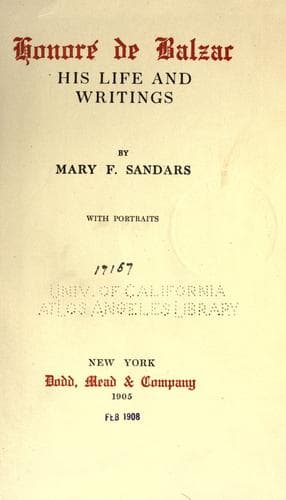
Honore de Balzac, His Life and WritingsSandars, Mary Frances
General
Honore de Balzac, His Life and Writings
Sandars, Mary Frances
Balzac, Honoré de, 1799-1850; Novelists, French -- 19th century -- Biography
Already in the grip of heart disease the agony he endured at this time
took him one stage further down the valley of death. In the end he
managed by frightening the thief, to effect the return of the letters
without any immediate payment; but the anguish he had passed through,
and the thought of the terrible consequences only just evaded, decided
him to burn all the letters he had received from Madame Hanska. It was
a terrible sacrifice. He describes in an unpublished letter to her his
feelings, as he sat by the fire, and watched each letter curl up,
blacken, and finally disappear. He had read and re-read them till they
had nearly dropped to pieces, had been cheered and comforted by the
sight of them when the world had gone badly, and had owned them so
long that they seemed part of himself. There was the first of all, the
herald of joy, the opening of a new life; and almost as precious at
this moment seemed the one which discovered to him the identity of his
correspondent, and held out hopes of a speedy meeting. One after
another he took them out of the box which had held some of them for
many years, and each seemed equally difficult to part with. However,
as he wrote to Madame Hanska, he knew that he was doing right in
destroying them, and that the painful sacrifice was absolutely
necessary.
Meanwhile, Emile de Girardin was naturally becoming impatient about
the continuation of "Les Paysans," which he had never received.[*] He
wrote to Balzac at the end of April, 1847, that the printer had been
ready for the finish of the book since the November before, and that
unless Balzac could produce it in June, the idea of its appearance in
_La Presse_ must be given up altogether; and in this case he must ask
the author to settle with M. Rouy about the advances of money already
made to him. He further remarked with scathing though excusable
distrust in Balzac's fulfilment of his business engagements, that he
refused to continue to bring out the work at all, unless he were
absolutely certain that it was completely written and that no further
interruption would ensue. Friendly social relations still subsisted,
however, between Balzac and the Girardins, as, about the same time
that Emile penned this uncompromising epistle, the following note
reached Balzac,[+] the last he ever received from the peace-making
Madame de Girardin:
"It is the evening of my last Wednesday. Come, cruel one. Mrs. Norton
will be here. Do you not wish me to have the glory of having presented
you to this English 'Corinne'? Emile tells me that 'La Derniere
Incarnation de Vautrin' is admirable. The compositors declare that it
is your _chef-d'oeuvre_.
"Only till this evening, I implore you.
"DELPHINE GAY DE GIRARDIN."
[*] "La Genese d'un Roman de Balzac," by the Vicomte de Spoelberch de
Lovenjoul, from which the whole account of Balzac's rupture with
Girardin is taken.
[+] "La Genese d'un Roman de Balzac," by the Vicomte de Spoelberch de
Lovenjoul, p. 262
Public-domain text, read in full here on John Shaqi.
Reviews
Reviews
No reviews yet
Be the first to share your thoughts on this work.
Elsewhere in the archive
Join the Discussion
Join the discussion
Sign in to leave a comment or review.
Sign InorCreate an account