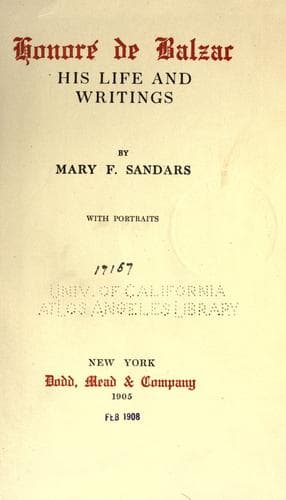
Honore de Balzac, His Life and WritingsSandars, Mary Frances
General
Honore de Balzac, His Life and Writings
Sandars, Mary Frances
Balzac, Honoré de, 1799-1850; Novelists, French -- 19th century -- Biography
His ever-active brain had now evolved a plan for transporting sixty
thousand oaks to France, from a territory on the Russian frontier
belonging to Count Georges Mniszech and his father. He was anxious
that M. Surville should undertake the matter, as, after abstruse and
careful calculations--which have the puzzling veneer of practicality
always observable in Balzac's mad schemes--he considered that
1,200,000 francs might be made out of the affair, and that of course
the engineer who arranged the transport would reap some of the
benefit. The blocks of wood would be fifteen inches in diameter at the
base, and ten at the top. They would first be conveyed to Brody, from
there by high road to Cracow, and thence they would travel to France
by the railway, which would be finished in a few days. Unfortunately,
there were no bridges at Cologne over the Rhine, or at Magdeburg over
the Elbe; but Balzac was not discouraged by the question of the
transshipment of sixty thousand oaks, any more than in his old days in
the Rue Lesdiguieres, he had been deterred from the idea of having a
piano, by the attic being too small for it. M. Surville was to answer
categorically, giving a detailed schedule of the costs of carriage and
of duty from Cracow to France; and to this, Balzac would add the price
of transport from Brody to Cracow. He discounted any natural
astonishment his correspondent would feel, at the neglect hitherto of
this certain plan for making a fortune, by remarking that the
proprietors were Creoles, who worked their settlements by means of
moujiks, so that the spirit of enterprise was entirely absent.[*] M.
Surville, however, received this brilliant proposition without
enthusiasm, and did not even trouble to write himself about the
matter, but sent back an answer by his wife, that the price of
transporting the freight from one railway to another at Breslau,
Berlin, Magdeburg, and Cologne, would render the scheme impossible.
Balzac showed unusual docility at this juncture; he was evidently
already half-hearted about the enterprise, and remarked that since his
first letter he had himself thought of the objections pointed out by
M. Surville, and had remembered hearing that a forest purchased in
Auvergne, had ruined the buyer, owing to the difficulty of transport.
[*] "Correspondance," vol. ii. p. 321.
Public-domain text, read in full here on John Shaqi.
Reviews
Reviews
No reviews yet
Be the first to share your thoughts on this work.
Elsewhere in the archive
Join the Discussion
Join the discussion
Sign in to leave a comment or review.
Sign InorCreate an account