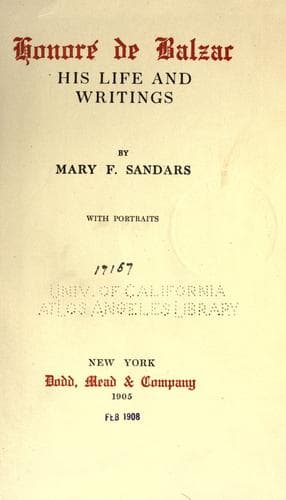
Honore de Balzac, His Life and WritingsSandars, Mary Frances
General
Honore de Balzac, His Life and Writings
Sandars, Mary Frances
Balzac, Honoré de, 1799-1850; Novelists, French -- 19th century -- Biography
Balzac was very happy at Wierzchownia, though the fulfilment of the
great desire of his life seemed still distant. Madame Hanska's
hesitation continued: she considered herself indispensable to her
children; besides, owing to the unfortunate state of the Chemin de Fer
du Nord, Balzac's pecuniary affairs would certainly be in an
embarrassed condition for the next two years. Living in the same house
with her, seeing her every day, and feeling sure of her affection, and
of a certain happy consummation to his long probation, would not after
all have been very painful, except for one great drawback, which
increased continually as time went on; and that was the terrible
effect of the inclement climate on Balzac's health. He had suffered
from heart disease for some years, and in a letter to his sister, he
traces its origin to the cruelty of the lady about whom she knows
--possibly Madame de Castries. His abuse of coffee, however, and the
unnatural life which he had led with the object of straining the
tension of every power to its uttermost, and thus of forcing the
greatest possible quantity and quality of literary work out of
himself, had done much to ruin his robust constitution. Nevertheless,
if he had been able to take up his abode with his wife in the Rue
Fortunee, and to enjoy the freedom from anxiety which her fortune
would have assured to him; if he had been happy with her, and
surrounded by his beautiful things, had at last lived the life for
which he had so long yearned, it seems as though several years at
least might have remained to him. The enormous labours of his earlier
years would indeed have been impossible,[*] but "Les Parents Pauvres"
had shown that his intellect was now at its best, and material for
many masterpieces was still to be found in that capacious brain and
fertile imagination. However, the rigours of the Russian climate,
aided no doubt by the privations and anxieties Balzac suffered in
Paris after the Revolution of 1848, and by the barbarous treatment
which he underwent at the hands of the doctor at Wierzchownia,
rendered his case hopeless; and at this time only one more stone was
destined to be laid on the unfinished edifice of the "Comedie
Humaine."
[*] "Balzac, sa Vie, son Oeuvre," by Julien Lemer.
In February, 1848, it was absolutely necessary that Balzac should go
to Paris, as money must at once be found, to meet the calls which the
ill-fated Chemin de Fer du Nord was making on its shareholders. Balzac
suffered terribly from cold on the journey, and arrived at the Rue
Fortunee at a most unfortunate time, just before the Revolution of
February, 1848.
Public-domain text, read in full here on John Shaqi.
Reviews
Reviews
No reviews yet
Be the first to share your thoughts on this work.
Elsewhere in the archive
Join the Discussion
Join the discussion
Sign in to leave a comment or review.
Sign InorCreate an account