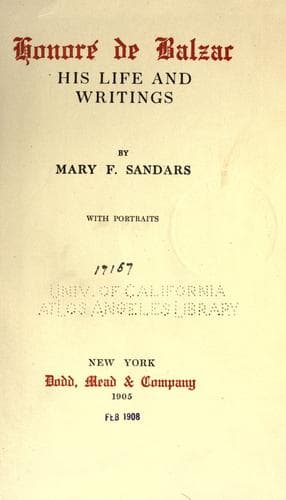
Honore de Balzac, His Life and WritingsSandars, Mary Frances
General
Honore de Balzac, His Life and Writings
Sandars, Mary Frances
Balzac, Honoré de, 1799-1850; Novelists, French -- 19th century -- Biography
There were fourteen statues in this gallery mounted on Buhl pedestals,
and all round the walls were richly decorated ebony buffets containing
_objets d'art_, while in the centre stood carved wooden cases, which
showed to great advantage some of the greatest rarities in human work
--costly jewellery, and curiosities in ivory, bronze, wood, and
enamel. Sixty-seven pictures adorned the walls of this magnificent
apartment, among them the four masterpieces, the loss of which is the
most tragic incident in the melancholy story of poor old Pons. There
were a "Chevalier de Malte en Priere," by Sebastian del Piombo; a
"Holy Family," by Fra Bartolommeo; a "Landscape," by Hobbema; and a
"Portrait of a Woman," by Albert Durer. Apparently they were in
reality mediocre as works of art, but they were a source of the utmost
pride and delight to their owner, who said enthusiastically of one of
them--the Sebastian del Piombo--that "human art can go no further."
When we know that in the novel Balzac is speaking of his own cherished
possessions, we think of his own words, "Ideas project themselves with
the same force by which they are conceived,"[*] and can understand the
reason of the positive pain we feel, when the poor old Cousin Pons is
bereft of his treasures. The great _voyant_ was transported by his
powerful imagination into the personality of the old musician, and the
heartrending situation he had evoked must have been torture to him;
though with the courage and conscientiousness of the true artist he
did not hesitate in the task he had set himself, but ever darkened and
deepened the shadows of his tragedy towards the close.
[*] "Le Pere Goriot," by Honore de Balzac.
It is not surprising to hear that this sumptuous house cost 400,000
francs, but it is astonishing, and it gives the inhabitant of
steady-going England an idea of the inconvenience of revolutions, that
its owner and occupant should in 1848 have been starving in the midst
of magnificence, and that it should have been impossible for him to
find a purchaser for some small curiosity, if he had wished to sell it
to buy bread. Part of the cost of the house had been defrayed by Madame
Hanska, but Balzac had evidently overstepped her limits, and had
involved himself seriously in debt. One of the alleged reasons given
by the lady for the further deferment of her promise to become Madame
Honore de Balzac, was the state of embarrassment to which Balzac had
reduced himself by his expenditure in decoration; and, in his despair
and disgust, the home he had been so happily proud of, and which
seemed destined never to be occupied, soon became to him "that
rascally plum box."
Public-domain text, read in full here on John Shaqi.
Reviews
Reviews
No reviews yet
Be the first to share your thoughts on this work.
Elsewhere in the archive
Join the Discussion
Join the discussion
Sign in to leave a comment or review.
Sign InorCreate an account