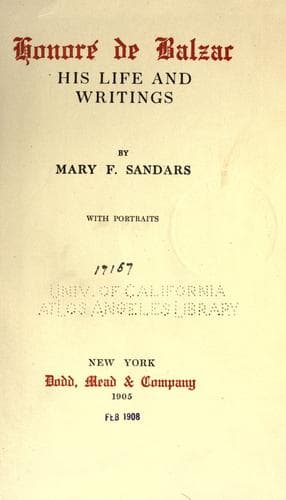
Honore de Balzac, His Life and WritingsSandars, Mary Frances
General
Honore de Balzac, His Life and Writings
Sandars, Mary Frances
Balzac, Honoré de, 1799-1850; Novelists, French -- 19th century -- Biography
1848 - 1849
Description of interior of house in the Rue Fortunee--"La Maratre"
--Projected plays--"Le Faiseur"--Balzac seeks admission for the
last time to the Academie Francaise--He returns to Wierzchownia
--Failing health--Letters to his family--Family relations are
strained.
During his stay in Paris, which lasted from February till the end of
September, Balzac was careful not to admit any strangers to the
mysterious little house in the Rue Fortunee. Even his trusted friends
were only shown the magnificence of his residence with strict
injunctions about secrecy, so afraid was he that the news of his
supposed riches should reach the ears of his creditors. He was only
the humble custodian, he said, of all these treasures. Nothing
belonged to him; he was poorer than ever, and was only taking charge
of the house for a friend. This was difficult to believe, and his
acquaintances, who had always been sceptical about his debts, laughed,
and said to his delight, yet annoyance, that he was in reality a
millionaire, and that he kept his fortune in old stockings.
Theophile Gautier, after remarking how difficult it was to gain an
entrance to this carefully-guarded abode, describes it thus: "He
received us, however, one day, and we were able to see a dining-room
panelled in old oak, with a table, mantelpiece, buffets, sideboards,
and chairs in carved wood, which would have made a Berruguete, a
Cornejo Duque, or a Verbruggen envious; a drawing-room hung with
gold-coloured damask, with doors, cornices, plinths, and embrasures
of ebony; a library ranged in cupboards inlaid with tortoiseshell
and copper in the style of Buhl; a bathroom in yellow breccia, with
bas-reliefs in stucco; a domed boudoir, the ancient paintings of which
had been restored by Edmond Hedouin; and a gallery lighted from the top,
which we recognised later in the collection of 'Cousin Pons.' On the
shelves were all sorts of curiosities--Saxony and Sevres porcelain,
sea-green horns with cracked glazing; and on the staircase which was
covered with carpet, were great china vases, and a magnificent lantern
suspended by a cable of red silk."[*]
[*] "Portraits Contemporains: Honore de Balzac," by Theophile Gautier.
The gallery, the holy of holies of this temple of Art, where the
treasures laboriously collected and long concealed, were at last
assembled, is described exactly in "Le Cousin Pons." It was a large
oblong room, lighted from the top, the walls painted in white and
gold, but "the white yellowed, the gold reddened by time, gave
harmonious tones which did not spoil the effect of the canvases."[*]
[*] "Le Cousin Pons," by Honore de Balzac.
Public-domain text, read in full here on John Shaqi.
Reviews
Reviews
No reviews yet
Be the first to share your thoughts on this work.
Elsewhere in the archive
Join the Discussion
Join the discussion
Sign in to leave a comment or review.
Sign InorCreate an account