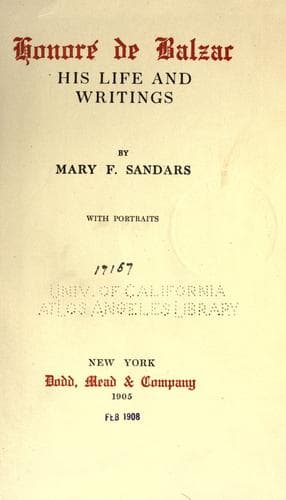
Honore de Balzac, His Life and WritingsSandars, Mary Frances
General
Honore de Balzac, His Life and Writings
Sandars, Mary Frances
Balzac, Honoré de, 1799-1850; Novelists, French -- 19th century -- Biography
must have been rather wearying to those who had not the felicity of
being acquainted with her. Apparently the young Countess possessed
deep knowledge without pedantry, and was of delicious naivete,
laughing like a little child; though this did not prevent her from
showing religious enthusiasm about beautiful things. Further, she was
of angelic goodness, intensely observant, yet extremely discreet, most
respectful to her adored mother, very industrious, and she lived only
for duty. "All these advantages are set off by a proud air, full of
good breeding, an air of ease and grandeur which is not possessed by
every queen, and which is quite lost in France, where every one wishes
to be equal. This outward distinction, this look of being a great
lady, is one of the most precious gifts which God, the God of women,
can bestow on them."[*] To paint her character aright, Balzac says, it
would be necessary to blend in one word virtues which a moralist would
consider it impossible to find united in a single human being; and her
"sublime education" was a crown to the whole edifice of her
perfections.
[*] "Correspondance," vol. ii. p. 345.
The only consolation which an impartial though possibly unprincipled
observer, might have offered at this point to the unfortunate Sophie
and Valentine, would be the fact that the young Countess was evidently
extremely plain, as even Balzac's partiality only allows him to say:
"Physically she possesses grace, which is more beautiful even than
beauty, and this triumphs over a complexion which is still brown (she
is hardly sixteen years old), and over a nose which, though well cut,
is only charming in the profile."
Let us hope, however, that our pity is after all wasted on the nieces,
and that in their joy at the idea of receiving handsome presents, they
either skipped the unwelcome portions of their distinguished uncle's
letter, or that, knowing the cause of his raptures, if they _did_
read, they laughed and understood.
His Polar Star is seldom mentioned by name in Balzac's letters; she is
generally "the person with whom I am staying," and he says little
about her, except that she is very much distressed at the amount of
his debts, and that the great happiness of his life is constantly
deferred. Two fires had taken place on the estate, and the Countess
was in addition burdened with three lawsuits: one about some property
which should have come to her from an uncle, and about which it would
be necessary for her to go to St. Petersburg. Balzac's letters as
usual abound in allusions to his monetary difficulties, while the
Survilles had been almost ruined by the Revolution of 1848, so that
the outlook for the family was black on all sides.
Public-domain text, read in full here on John Shaqi.
Reviews
Reviews
No reviews yet
Be the first to share your thoughts on this work.
Elsewhere in the archive
Join the Discussion
Join the discussion
Sign in to leave a comment or review.
Sign InorCreate an account