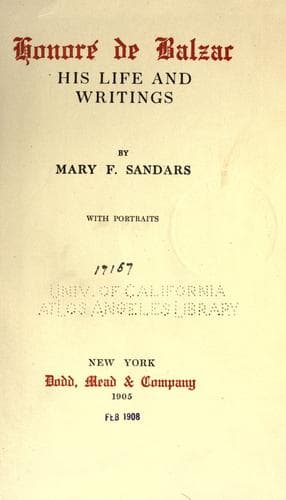
Honore de Balzac, His Life and WritingsSandars, Mary Frances
General
Honore de Balzac, His Life and Writings
Sandars, Mary Frances
Balzac, Honoré de, 1799-1850; Novelists, French -- 19th century -- Biography
All this time Balzac's relations were becoming more and more
discontented with his doings, as well as with the general aspect of
his affairs. Honore was evidently pursuing a chimera, and because of
his illusions, many burdens were imposed on them. Madame de Balzac the
principal sufferer, was tired of acting as custodian at the Rue
Fortunee, where she was expected to teach Francois how to clean the
lamps, and received careful instructions about wrapping the gilt
bronzes in cotton rags. It seemed as though her son were permanently
swallowed up by that terrible Russia, about which, as he remarked
impatiently, she would never understand anything; and she longed to
retire to her little lodgings at Suresnes, and to do as she pleased.
Laure, too, had her grievances, though possibly she kept them to
herself and strove to act as peacemaker. She and her family were in
terrible monetary straits, and the sight of the costly house, which
seemed destined never to be occupied, must have been slightly
exasperating. She was quite willing to be useful to Honore, and did
not mind when troublesome commissions were entrusted to her; but it
was no doubt galling to notice that--though her daughters were
expected to write continually, and were supposed to be amply rewarded
for their labours, by hearing of the delight with which the young
Countess listened to their letters--a strong motive lurking behind
Balzac's anxiety to hear often from his family, was the desire to
impress Madame Hanska favourably with the idea of their affection for
himself, and their unity. At the same time, a sad presentiment warned
her, that if ever her brother were married to this great lady, his
family and friends would see little more of him. The prospect cannot
have been very cheerful to poor Laure, as either Honore would return
to France brokenhearted and overwhelmed with debt, or he would gain
his heart's desire, and would be lost to his family.
The tone of Balzac's letters to his relations at this time has been
adversely criticised, and it is true that the reader is sometimes
irritated by the frequency of his requests for service from them, and
his continual insistence on the wonderful perfections of the Hanski
family, and their grandeur and importance. Occasionally, too, his
letters show an irritability which is a new feature in his character.
We must remember, however, in judging Balzac, that he was nearly
driven wild by the position in which he found himself. It was
necessary that he should always be bright, good-natured, and agreeable
to the party at Wierzchownia, and his letters to his family were
therefore the only safety-valve for the impatience and despair, which,
though he never utters a word of reproach against Madame Hanska, must
sometimes have taken possession of him.
Public-domain text, read in full here on John Shaqi.
Reviews
Reviews
No reviews yet
Be the first to share your thoughts on this work.
Elsewhere in the archive
Join the Discussion
Join the discussion
Sign in to leave a comment or review.
Sign InorCreate an account