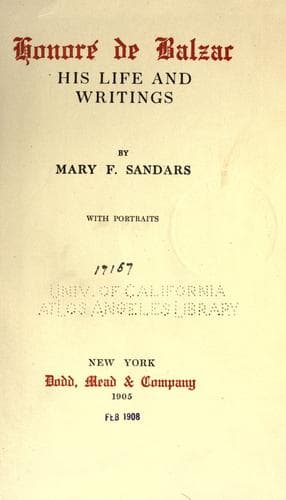
Honore de Balzac, His Life and WritingsSandars, Mary Frances
General
Honore de Balzac, His Life and Writings
Sandars, Mary Frances
Balzac, Honoré de, 1799-1850; Novelists, French -- 19th century -- Biography
He put the case to Madame Surville as if it were her own, and asked
what her course would be if she were rich, and Sophie an heiress with
many suitors. Sophie, according to her uncle's hypothesis, was in love
with a young sculptor; and her parents had permitted an engagement
between the two. The sculptor, however, came to live in the same house
with his _fiancee_, and his family wrote him letters which he showed
to Madame Surville, containing damaging revelations about family
matters. As a culminating indiscretion, his mother wrote to this
sculptor, "who is David, or Pradier, or Ingres," a letter in which she
treated him like a street boy. What would Laure do in these
circumstances? Balzac asks. Would she not in disgust dismiss the
sculptor, and choose a more eligible _parti_ for Sophie?
"Unsatisfactory marriages," he remarks sagely, "are easily made; but
satisfactory ones require infinite precautions and scrupulous
attention, or one does not get married; and I am at present most
likely to remain a bachelor."[*]
[*] "Correspondance," vol. ii. p. 328.
He appeals to Madame Surville's self-interest. "Reflect on the fact,
my dear Laure, that not one of us can be said to have arrived at our
goal, and that if, instead of being obliged to work in order to live,
I were to become the husband of a most intellectual, well born and
highly connected woman, with a solid though small fortune--in spite of
this woman's desire to remain in her own country and to make no new
relations, even family ones--I should be in a much more favourable
position to be useful to you all. I know that Madame Hanska would show
kindness to and feel keen interest in your dear little ones."
Surely, he says, it will be an advantage to the whole family, when he
has a _salon_ presided over by a beautiful, clever woman, imposing as
a queen, where he can assemble the _elite_ of Parisian society. He
does not wish to be tyrannical or overbearing with his family, but he
informs them that it will be of no use to place themselves in
opposition to such a woman. He warns them that she and her children
will _never forgive_ those who blame him to them. Further on in his
lengthy epistle, he gives instructions in deportment, and tells his
relations that in their intercourse with Madame Hanska they must not
show servility, haughtiness, sensitiveness, or obsequiousness; but
must be natural, simple, and affectionate. It was no wonder that the
Balzac family disliked Madame Hanska! And the poor woman cannot be
considered responsible for the feeling evoked!
Public-domain text, read in full here on John Shaqi.
Reviews
Reviews
No reviews yet
Be the first to share your thoughts on this work.
Elsewhere in the archive
Join the Discussion
Join the discussion
Sign in to leave a comment or review.
Sign InorCreate an account