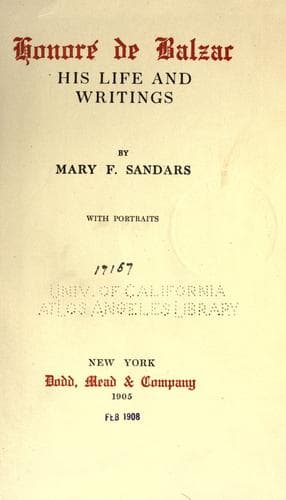
Honore de Balzac, His Life and WritingsSandars, Mary Frances
General
Honore de Balzac, His Life and Writings
Sandars, Mary Frances
Balzac, Honoré de, 1799-1850; Novelists, French -- 19th century -- Biography
In reply, she wrote a severe reprimand to her son, in which she
addressed him as "vous," and remarked that her affection in future
would depend on his conduct. In fact, as Balzac wrote hotly to Laure,
it was the letter of a mother scolding a small boy, and he was fifty
years old! Unfortunately, too, it arrived during the _dejeuner_, and
Balzac cried impulsively, "My mother is angry with me!" and then was
forced to read the letter to the party assembled. It made a very bad
impression, as it showed that either he was a bad son, or his mother
an extremely difficult person to get on with. Fate had chosen an
unfavourable moment for the arrival of this missive, which, later on,
when her wrath had abated, Madame de Balzac announced that she had
written partly in jest. Balzac had at last been allowed to write to
St. Petersburg, to beg the Czar's permission for his marriage with
Madame Hanska, and this had been very decidedly refused. Madame Hanska
was not at this time prepared to hand over her capital to her
daughter, and thus to take the only step, which would have induced her
Sovereign to authorise her to leave his dominions. She therefore
talked of breaking off the engagement, and of sending Balzac to Paris,
to sell everything in the Rue Fortunee. She was tired of struggling;
and in Russia she was rich, honoured, and comfortable, whereas she
trembled to think of the troublous life which awaited her as Madame
Honore de Balzac. Madame de Balzac's letter further strengthened her
resolve. Apparently, in addition to evidence about family dissensions,
it contained disquieting revelations about the discreditable Henri,
and the necessity for supporting the Montzaigle grandchildren; and the
veil with which Balzac had striven to soften the aspect of the family
skeletons was violently withdrawn. He was in despair. At this juncture
his mother's communication was fatal! She had done irreparable
mischief!
The long letter he wrote to Madame Surville,[*] imploring her to act
as peacemaker, and insisting on the benefits which his marriage would
bring to the whole family, would be comical were it not for the
writer's real trouble and anxiety; and the reader's knowledge that,
underlying the common-sense worldly arguments--which were brought
forward in the hope of inducing his family to help him by all the
means in their power--was real romantic love for the woman who had now
been his ideal for sixteen years.
[*] "Correspondance," vol. ii. p. 378.
Public-domain text, read in full here on John Shaqi.
Reviews
Reviews
No reviews yet
Be the first to share your thoughts on this work.
Elsewhere in the archive
Join the Discussion
Join the discussion
Sign in to leave a comment or review.
Sign InorCreate an account