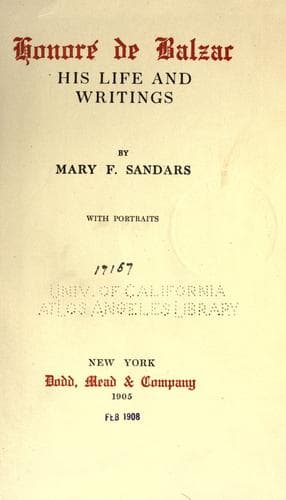
Honore de Balzac, His Life and WritingsSandars, Mary Frances
General
Honore de Balzac, His Life and Writings
Sandars, Mary Frances
Balzac, Honoré de, 1799-1850; Novelists, French -- 19th century -- Biography
The travellers did not arrive at the Rue Fortunee till late at
night.[*] The house was brilliantly lit, and through the windows they
could see the flowers with which the rooms were decorated; but in vain
they rang at the courtyard gate--no one appeared to let them in. It
was a miserable arrival, and utterly inexplicable, as Balzac had
planned the arrangements most carefully beforehand, going minutely
into commissariat details, that his bride might find everything
absolutely comfortable on her arrival in her new home. It was
impossible to force an entrance, so M. and Madame Honore de Balzac,
utterly worn out by the fatigues of the journey, and longing for rest,
were obliged to sit in the carriage and spend the time in agitation
and vain conjecture, while a messenger was despatched for a locksmith.
When the door was at last opened, a terrible solution to the problem
presented itself. The excitement and strain of the preparations, and
of the hourly expectation of the travellers, had completely upset the
mental balance of the unfortunate Francois, and he had gone suddenly
mad! It was a sinister omen, a wretched commencement to Balzac's home
life; and he, always superstitious, was no doubt doubly so in his
invalided and suffering condition. Francois Munch was sent to a
lunatic asylum, where he was cared for at his master's expense.
[*] "Un Roman d'Amour," by the Vicomte de Spoelberch de Lovenjoul.
CHAPTER XVII
1850 AND AFTER
Balzac's ill-health--Theophile Gautier and Victor Hugo--Balzac's
grief about the unfinished "Comedie Humaine"--His interview with
the doctor--Victor Hugo's account of his death-bed--Balzac's death
and funeral--Life afterwards in the Rue Fortunee--Reckless
extravagance--House rifled at Madame de Balzac's death--Fate of
Balzac's MSS.--His merits as a writer.
When Balzac's friends came to visit him in the Rue Fortunee, they were
much shocked by the change in his appearance. His breathing was short,
his speech jerky, and his sight so bad that he was unable to
distinguish objects clearly. Nevertheless, as Gautier says,[*] every
one felt such intense confidence in his wonderful constitution that it
seemed impossible to think of a probably fatal result to his malady.
Balzac himself, optimistic as ever, clung persistently to his hope of
speedy recovery. His fame was now at its zenith, the series entitled
"Les Parents Pauvres" had awakened the utmost enthusiasm; and the
_elite_ of the Parisian world were eager to flock to the Rue Fortunee
to stare at the curiosities collected there, and to make the
acquaintance of Balzac's rich and distinguished Russian wife.
[*] "Portraits Contemporains: Honore de Balzac," by Theophile Gautier.
However, in his native country, Balzac was destined never to receive a
full guerdon of adulation and admiration; for though he was visited by
a few friends, the doctors insisted on keeping him otherwise in the
strictest retirement.
Public-domain text, read in full here on John Shaqi.
Reviews
Reviews
No reviews yet
Be the first to share your thoughts on this work.
Elsewhere in the archive
Join the Discussion
Join the discussion
Sign in to leave a comment or review.
Sign InorCreate an account