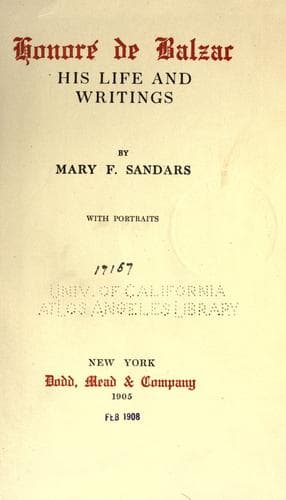
Honore de Balzac, His Life and WritingsSandars, Mary Frances
General
Honore de Balzac, His Life and Writings
Sandars, Mary Frances
Balzac, Honoré de, 1799-1850; Novelists, French -- 19th century -- Biography
Theophile Gautier relates that he went to the Rue Fortunee to say
good-bye to his friend before starting for Italy, and, though
disappointed not to see him, was relieved about his health when told
that he was out driving. However, a little later, a letter was brought
to Gautier which had been dictated by Balzac to his wife, in which he
explained that he had only gone to the Customhouse to get out some
luggage, and had done this against the express orders of his doctors.
However, he spoke cheerfully of his health, saying that he was feeling
better, and that the next day the doctors intended to attack the
chronic malady from which he was suffering. For two months at least he
expected to be kept like a mummy, and not to be allowed to speak or to
move; but there were great hopes of his ultimate recovery. If Gautier
came again, he hoped for a letter beforehand naming the day and hour,
that he might certainly be at home; as in the solitude to which he was
doomed by the doctors, his friend's affection seemed to him more
precious than ever. All this was written in Madame de Balzac's
handwriting, and under it Balzac had scrawled: "I can neither read nor
write!"[*] Gautier left for Italy soon after this, and he never saw
his friend again. He read the news of Balzac's death in a newspaper
when he was at Venice, taking an ice at the Cafe Florian, in the
Piazza of St. Mark; and so terrible was the shock, that he nearly fell
from his seat. He tells us that he felt for the moment unchristian
indignation and revolt, when he thought of the octogenarian idiots he
had seen that morning at the asylum on the island of San Servolo, and
then of Balzac cut off in his prime; but he checked himself, for he
remembered that all souls are equal in the sight of God.
[*] "Portraits Contemporains: Honore de Balzac," by Theophile Gautier.
Victor Hugo also visited the invalid, and says that even a month
before his death he was perfectly confident about his recovery, and
was gay and full of laughter, discussing politics, stating his own
legitimist views with decision, and accusing his visitor of being a
demagogue. He said: "I have M. de Beaujon's house without the garden,
but I am owner of the gallery leading to the little church at the
corner of the street. A door on my staircase leads into the church.
One turn of the key, and I am at Mass. I care more for the gallery
than for the garden."[*]
[*] "Choses Vues," by Victor Hugo.
Public-domain text, read in full here on John Shaqi.
Reviews
Reviews
No reviews yet
Be the first to share your thoughts on this work.
Elsewhere in the archive
Join the Discussion
Join the discussion
Sign in to leave a comment or review.
Sign InorCreate an account