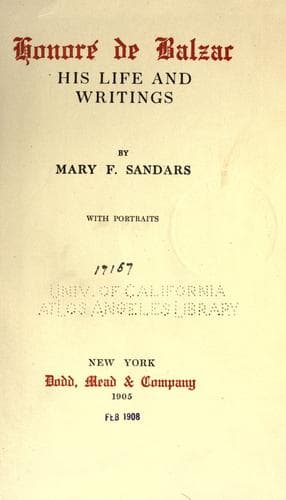
Honore de Balzac, His Life and WritingsSandars, Mary Frances
General
Honore de Balzac, His Life and Writings
Sandars, Mary Frances
Balzac, Honoré de, 1799-1850; Novelists, French -- 19th century -- Biography
Balzac died that night, Sunday, August 17th, 1850, at half-past
eleven, at the age of fifty-one.
The dying man's almost complete isolation is strange, and the
servant's news that M. Surville had not _yet_ gone to bed has a
callous ring about it. Perhaps, however, the doctors had told Madame
de Balzac and Madame Surville that Balzac was unconscious, and they
had therefore withdrawn, utterly exhausted by the fatigues of the
night before. In any case, it seems sad, though possibly of no moment
to the dying man, that several of his nearest relations should have
deserted him before the breath had left his body. Our respect for the
elder Madame de Balzac is decidedly raised, because, though there had
occasionally been disagreements between her and her son, the true
mother feeling asserted itself at the last, and she alone watched with
the paid attendants till the end came.
However, some one was busy about the arrangements, as Balzac's
portrait was taken by Giraud directly after his death, and a cast was
made of his beautifully-shaped hand. His body was taken into the
Beaujon Chapel before burial, so that he passed for the last time, as
Victor Hugo remarks, through that door, the key of which was more
precious to him than all the beautiful gardens which had belonged to
the old Farmer-General.
The funeral service was held on Wednesday, August 20th, at the Church
of Sainte Philippe du Roule. The rain was descending in torrents, but
the procession, followed by a large crowd, walked the whole way across
Paris to the Cemetery of Pere-la-Chaise, where the interment took
place. The pall-bearers were Victor Hugo, Alexandre Dumas, Monsieur
Baroche, and Sainte-Beuve. At the grave Victor Hugo spoke, finishing
with the words: "No, it is not the Unknown to him. I have said this
before, and I shall never tire of repeating it: it is not darkness to
him, it is Light! It is not the end, but the beginning; not
nothingness, but eternity! Is not this the truth, I ask you who listen
to me? Such coffins proclaim immortality. In the presence of certain
illustrious dead, we understand the divine destiny of that intellect
which has traversed earth to suffer and to be purified. Do we not say
to ourselves here, to-day, that it is impossible for a great genius in
this life to be other than a great spirit after death?"[*]
[*] "Funerailles de Balzac," in "Actes et Paroles," by Victor Hugo.
The Cemetery of Pere-la-Chaise had been one of Balzac's favourite
haunts in the old half-starved days of the Rue Lesdiguieres. "Here I
am back from Pere-la-Chaise," he wrote to his sister in 1820,[*] "and
I have brought with me some good big inspiring reflections. Decidedly,
the only fine epitaphs are these: La Fontaine, Messena, Moliere, a
single name, which tells all and makes one dream." Probably Madame
Surville remembered these words and repeated them to Madame Honore de
Balzac, for the monument erected to Balzac is a broken column with his
name inscribed on it.
Public-domain text, read in full here on John Shaqi.
Reviews
Reviews
No reviews yet
Be the first to share your thoughts on this work.
Elsewhere in the archive
Join the Discussion
Join the discussion
Sign in to leave a comment or review.
Sign InorCreate an account