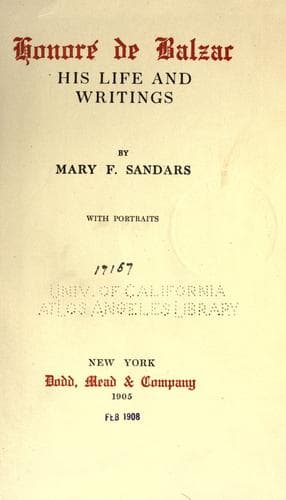
Honore de Balzac, His Life and WritingsSandars, Mary Frances
General
Honore de Balzac, His Life and Writings
Sandars, Mary Frances
Balzac, Honoré de, 1799-1850; Novelists, French -- 19th century -- Biography
[*] "Correspondance," vol. i. p. 24.
The fortunes of the inhabitants of the Rue Fortunee were not happy
after Balzac's death. Madame Honore de Balzac's contemporaries
considered that she as not really as overwhelmed with sorrow at her
husband's death as she appeared to be, and that when she wrote
heartbroken letters, she slightly exaggerated the real state of her
feelings; but she assumed gallantly the burdens laid upon her by the
state of pecuniary embarrassment in which her husband died. If Balzac
had lived longer and had been able to work steadily, there is little
doubt that he would in a few years have become a free man, as the
Vicomte de Spoelberch de Lovenjoul tells us[*] that in the years
between 1841 and 1847, after which date his productions became very
rare, he had enormously diminished the sum he owed.
[*] "La Genese d'un Roman de Balzac," by the Vicomte de Spoelberch de
Lovenjoul.
Under Balzac's will his widow might have refused to acknowledge any
liability for his debts, but she set to work bravely, with the aid of
MM. Dutacq and Fessart, to make as much money as she could out of
Balzac's published works, and to bring before the public those that
were still unpublished. In this way, "Mercadet le Faiseur" was acted a
year after Balzac's death, and "Les Petits Bourgeois" and "Le Depute
d'Arcis" were published, the latter being finished, according to
Balzac's wish, by Charles Rabou. "Les Paysans," which was to have
filled eight volumes, and of which, as we have already seen, only a
few chapters were written, presented great difficulty; but at last
Madame de Balzac, aided by Champfleury and by Charles Rabou, managed
to give some consistency to the fragment, and it appeared in the
_Revue de Paris_ in April, May and June, 1855. Unfortunately, however,
no information was given as to the unfinished state in which it had
been left by Balzac, and therefore no explanation was offered of the
insufficiency of the _denouement_, and the inadequacy of the last
chapters. Madame de Balzac worked hard, and long before her death in
April, 1882, the whole of Balzac's debts were paid off.
This was most creditable to her; but side by side with her admirable
conduct in this respect, she seems to have either actively abetted, or
at any rate acquiesced in mad extravagance on the part of Madame
Georges Mniszech, who with her husband, had come to live in the Rue
Fortunee after Balzac's death. Perhaps Madame de Balzac was too busy
with her literary and business arrangements, to pay attention to what
was happening, or possibly maternal devotion prevented her from
denying her beloved daughter anything she craved for. At all events
the results of her supineness were lamentable, especially as M.
Georges Mniszech was not capable of exercising any restraint on his
wife; he being for some years before his death in 1881, in the most
delicate state of health, both mental and physical.
Public-domain text, read in full here on John Shaqi.
Reviews
Reviews
No reviews yet
Be the first to share your thoughts on this work.
Elsewhere in the archive
Join the Discussion
Join the discussion
Sign in to leave a comment or review.
Sign InorCreate an account