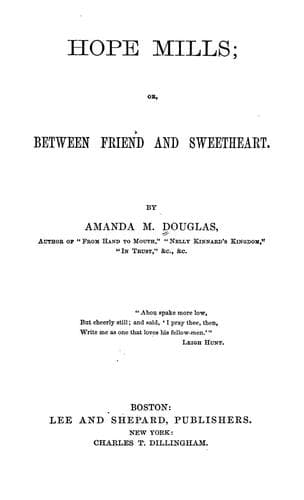
Hope Mills; Or, Between Friend and SweetheartDouglas, Amanda M.
Philosophy
Hope Mills; Or, Between Friend and Sweetheart
Douglas, Amanda M.
Fiction
Already a great concourse had assembled. Mr. McPherson mounted his
rostrum, and, after a few preliminary flourishes, began in a clear,
strong tone, that had the power of concentrating the attention of his
audience. He went back centuries, and proved that from the very
beginning of all industries there had been the desire to oppress, that
the working-classes had to combine and fight for every advantage gained,
to wrest from kings, peers, masters, even equals, the privileges they
held to-day. Plainly, capital was a tyrant fattening on unpaid toil.
"Were not the rich always in the ranks of capital, always against the
poor man? They squeezed him to the utmost when they had need, then they
flung him away. Did it matter to them if his wife and children starved?
If he stole a loaf of bread to appease the pangs of hunger, he was sent
to prison; but if a bank president stole half a million, he went
to--Europe! [Laughter and applause.] Does the capitalist employ the
laborer in order that there shall be fewer starving men in the country?
It comes in the market, and buys at the lowest price, solely for its own
benefit. It does not concern capital, whether this man can support wife
and children on such a pittance: what business has he with wife and
children! If the man drops at the work-bench, the victim of long hours,
exhaustive toil, insufficient food, the town will thrust him into a
pauper's grave, and another will fill his place. Even negro-slavery was
more noble than this: it was to the master's interest that the slave
should be well fed. Capital was shrewd, selfish, experienced, astute,
strong: labor was kept in ignorance lest it might learn its worth, its
rights; it was half-starved that it might be weak; it was driven from
pillar to post with a more cruel than slave-driver's whip, that it might
never be able to perfect a successful organization."
And so on and on. The crowd increased. The six-o'clock bells rang, and
the procession from shops wended their way thither, many from curiosity,
some from a hope of a new truth, and not a few filled with a secret
sense of wrong and dissatisfaction. Mr. McPherson was still belaboring
capital. Now he had declared it "a stupendous fraud, a hollow bubble, a
reputation for wealth where no wealth existed, a fictitious claim for
what was not, but which still managed to hold the workman in its iron
grasp; the concentrated labor of the men, not the lawful working
interest of money. Some way this system of evil was going to be uprooted
by men standing firm, refusing the wages of sweat and blood; and in the
general overturn by legislation of state and country, every man was to
have a farm or a factory, to quit work in the middle of the afternoon,
and sit with folded hands on his own door-step, his own master, a free
man!" [Great shouting and applause.]
Public-domain text, read in full here on John Shaqi.
Reviews
Reviews
No reviews yet
Be the first to share your thoughts on this work.
Elsewhere in the archive
Join the Discussion
Join the discussion
Sign in to leave a comment or review.
Sign InorCreate an account