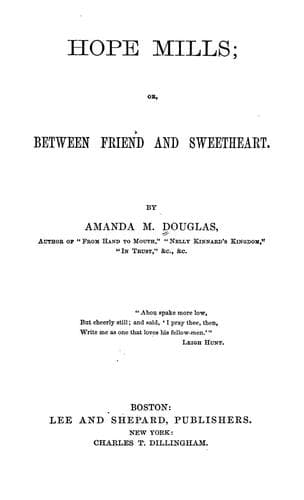
Hope Mills; Or, Between Friend and SweetheartDouglas, Amanda M.
Philosophy
Hope Mills; Or, Between Friend and Sweetheart
Douglas, Amanda M.
Fiction
He talked until seven, and wound up at last with a desperate but covert
onslaught on Hope Mills. "No two men or six men, or company of any kind,
had a right to band together to starve not only the men in their own
town, but the laborers throughout the world, by so reducing wages for
their own sole benefit; and every workman who submitted to have these
chains forged around body and soul, no matter by what specious
expedient, was a worse traitor, a more cruel oppressor of wife and
children, than the red-handed capital that stood ready to make him a
slave!"
There was an immense deal of cheering and applause. Mr. McPherson was
invited to supper at the Bedell House by a deputation of working-men,
though I think there were few horny-handed ones among them. Liquors
flowed freely, and the feast was rather noisy. A purse was handed to him
when he went away--he was too noble to make any charge when he spoke in
behalf of a cause so near his heart.
The seed was sown, and it is too true that "foul weeds grow apace."
There were club-meetings and union-meetings. The shoe-factory, which had
struggled hard to get on its legs again, soon became a hotbed of
discontent. The hatters held meetings, the paper-makers were aroused,
and then began preparation for another grand strike. The weavers from
Coldbridge and Stilford sent over a deputation to Hope Mills, warning,
exhorting, and threatening. "No system," said they, "should interfere
with mutual strength and protection."
And this was not all. It seemed as if Yerbury meant to make them the
scape-goat of every thing. Robert Winston was broadly caricatured; and
there was a bit of insulting abuse, calling them traders in their
brethren's blood, pasted up on the gate-post. "The Evening Transcript"
went over the system of co-operation, and showed to its own
satisfaction, that it was a system full of errors and miscalculations
based on the credulity of workmen. It hinted that the same mysterious
cause which reduced profits last year would reduce them again next year,
that at the end of the five years the bread and cheese would come out
just even, although there had been a great deal more bread than cheese,
as everybody knew. If the corporation were working for the best
interests of the men, why had they not sold off stock when every one
knew prices were going permanently down, instead of waiting to sell it
below cost? Why had they paid exorbitant prices for wool when the market
was flooded with it? Why had they not done this or that? until one
wondered why, understanding the woollen-business so well, and being able
to see just where enormous profits could be made, and losses avoided,
they had not all gone into it themselves. The article wound up with a
covert and insulting insinuation. Human nature was the same, the world
over. Men of the highest probity and honor had succumbed to temptation:
these men who had never really been in any responsible position had yet
to be proved.
Public-domain text, read in full here on John Shaqi.
Reviews
Reviews
No reviews yet
Be the first to share your thoughts on this work.
Elsewhere in the archive
Join the Discussion
Join the discussion
Sign in to leave a comment or review.
Sign InorCreate an account