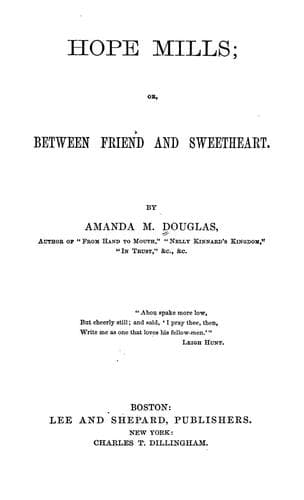
Hope Mills; Or, Between Friend and Sweetheart — John Shaqi
Hope Mills; Or, Between Friend and SweetheartDouglas, Amanda M.
Philosophy
Hope Mills; Or, Between Friend and Sweetheart
Douglas, Amanda M.
Fiction
So Sylvie read and talked, and sang two or three songs before she went
home. Then she came again and again, sometimes with her aunt, oftener
alone. Miss Barry took duty calls with her neighbors as one of the
demands of society, to be fulfilled with the fine grace of thorough
good-breeding. Beyond the little formalities that always surrounded her
like a delicate hoar-frost, there was a large heart for the weal and woe
of all who could in any way be benefited.
"It is a pity to see such a waste of life," she said of Mrs. Lawrence.
"Some people, after they have served their own turn, and had their good
time, set about doing something for God and their neighbors at the
eleventh hour; but she still clings to self, even when all the pleasure
has dropped out. If she only would exert herself a little, her health
and interest would improve, and she has so much in her hands."
One day Sylvie had turned the last leaf of her book, when Fred Lawrence
crossed the hall, having come home unexpectedly half an hour before.
"Miss Sylvie is with your mother," the housekeeper had said; and he had
begged that they should not be disturbed. He stood now listening to the
cool, soft voice, and an odd thought entered his mind.
Sylvie should really be a daughter of the house. How his mother liked
her, depended upon her! She was not always going to watering-places and
parties and theatres, she did not talk continually of dress and
conquests. He did not despise cultivated elegance: in fact, it was a
strong point with all the Lawrences; but he knew that a great deal of
this much-praised culture ran into artificiality, while Sylvie's
elegance had the comprehensiveness of nature. It would be quite
impossible for her to do an awkward or ungraceful act; for her innate
sense of beauty, harmony, and right guided her. Something higher than
worldly maxims toned her soul. And though he, a man with his hands full
of gold that he had never earned, could content himself with indolent
dilettanteism, he wanted an earnest, honest, truthful woman, if he ever
took a wife. He had flirted in a lazy fashion, common with young men who
find themselves an object to women, and who have only to raise their
hand, sultan-like, to bring a host of houris. That he had kept out of
many grosser pleasures was perhaps a credit to him, although that was
not the weak side of his character.
He did not fall in love with the picture before him, sweet as it
was,--the young girl in a soft flowing white dress (she was too true an
artist to have starchy outlines), the shimmering hair, the delicate
wavering color, the proud poise of the head, the plump white arm and
slender fingers with their pale-pink nails, and, above all, the
exquisite voice that seemed so to enter into the culmination of the
story, the last few sentences of pathos, joy, and complete fruition.
Public-domain text, read in full here on John Shaqi.
Reviews
Reviews
No reviews yet
Be the first to share your thoughts on this work.
Join the Discussion
Join the discussion
Sign in to leave a comment or review.
Sign InorCreate an account