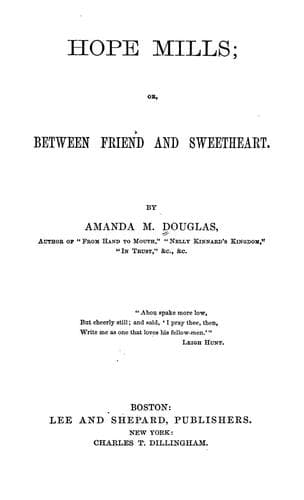
Hope Mills; Or, Between Friend and SweetheartDouglas, Amanda M.
Philosophy
Hope Mills; Or, Between Friend and Sweetheart
Douglas, Amanda M.
Fiction
"Money is not every thing," answered the young girl, with a touch of
sharpness. "Are one's own desires and old associations to count for
nothing? This place was very dear to my aunt and to many others. I am
sure there is quite enough of Yerbury laid waste now. The town looks as
if it were a sort of general house-cleaning, and every thing was thrust
out of doors and windows. And it was so pretty!" with a curious heat and
passion. "It was like a dream, with its winding river and green fields,
and men at their hay, and cows grazing in knee-deep pastures. Now all
the milkmaids are herded in mills and factories; and the
children,--well, there are no children any more!"
"No children!" lifting his pencilled brows in languid surprise. "Why, I
think you can find swarms of them. The poorer the man, the larger the
family."
"There are babies and babies; then little prigs and drudges. I am not
sure I am in love with the so-called civilization. For the great
majority it only means harder work."
"Did we not learn in some school-book--I am quite sure I did--that
'Satan finds some mischief still,
For idle hands to do'?"
"Are you not afraid?" She turned with a bright, tormenting smile to the
handsome young fellow, who flushed under her clear glance.
"For those who have brains, manual labor may not be the only chance of
salvation," he returned with a somewhat haughty flippancy.
"I wonder they do not turn their brains to some account."
They reached the gate, and Miss Barry was sitting on the porch. Sylvie
was too pretty and too womanly to be quarrelled with for the sake of a
subject that did not in the least interest him. Beside, he meant to come
in; so he opened the gate for her, and followed in a well-bred,
gentlemanly way, that had nothing obtrusive in it. Miss Barry welcomed
him with the quaint formality, the subtile air of education, refinement,
and morality, so much a part of herself. It pleased him extremely, and
settled him in his determination.
"Sylvie has a touch of radicalism," he mused to himself; "but it is a
disease of youth, and thrives by association. Take her quite away, and
she will soon recover her normal tone."
He found his mother still up on his return, and rather restless. She lay
on her sofa, and dozed so much through the day, that night had but
little slumber to bring her.
"I am so glad you did not go to Long Branch," she remarked, as she toyed
with her son's silken, perfumed hair. "I get so lonesome when your
father is away; and he seems to think of nothing but business"--in a
complaining tone. "I do not know what I should do but for Sylvie. She is
such a charming little body! Fred, do you think there is any truth in
Gertrude's gossip about her and that--one of your father's mill-hands,
is it not? How can Miss Barry allow it?"
Public-domain text, read in full here on John Shaqi.
Reviews
Reviews
No reviews yet
Be the first to share your thoughts on this work.
Join the Discussion
Join the discussion
Sign in to leave a comment or review.
Sign InorCreate an account