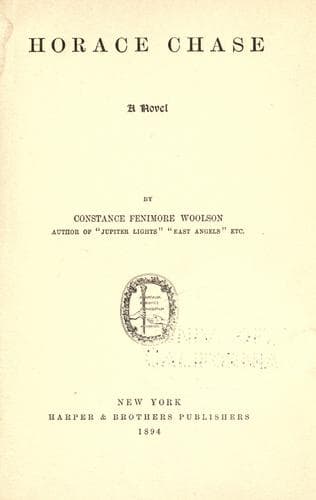
Didactic fiction; Men -- United States -- Fiction; United States -- Social life and customs -- 19th century -- Fiction
When, two years before, absorbed in her love for Walter, she had
insisted upon that long, solitary voyage northward from Charleston, so
that she could give herself up uninterruptedly to her own thoughts,
alone with them and the blue sea, the tidings which had met her at New
York as she landed--the tidings of her brother's death--had come upon
her almost like a blinding shaft of lightning. It was as if she, too,
had died. And she found her life again only partially, as she went
southward in the rushing trains, as she crossed the mountains in the
wagon, and arrived by night at dimly lighted L'Hommedieu. Sleepless
through both journeys--the voyage northward and the return by
land--worn out by the intense emotions which, in turn, had swept over
her, she had reached her mother's door at last so exhausted that her
vital powers had sunk low. Then it was that the gentle care of the man
who knew nothing of the truth had saved her--saved her from the
dangerous tension of her own excitement, and, later, from a death-like
faintness which, if prolonged, would have been her end. For when she
beheld the changed, drawn, unconscious face of her mother, that "mother"
who had seemed to her as much a fixed part of her life as her own
breath, her heart had failed her, failed not merely in the common
meaning of the phrase, but actually; its pulsations grew so weak that a
great dread seized her--the instinctive shrinking of her whole young
being from the touch of death. In her terror, she had fled to her
husband, she had taken refuge in his boundless kindness. "Oh, I am
dying, Horace; I _must_ be dying! Save me!" was her frightened cry.
For she was essentially feminine. In her character, the womanhood, the
sweet, pure, physical womanhood, had a strong part; it had not been
refined away by over-development of the mental powers, or reduced to a
subordinate position by ascetic surroundings. It remained, therefore,
what nature had made it. And it gave her a great charm. But its presence
left small place for the more masculine qualities, for stoical fortitude
and courage; she could not face fear; she could not stand alone; and
she had always, besides, the need to be cherished and protected, to be
held dear, very dear.
This return to her husband was sincere as far as it carried her. From
one point of view, it might be said that she had never left him. For her
love for Walter had contained no plan; and her girlish affection for
Horace Chase remained what it always had been, though the deeper
feelings were now awake underneath.
Public-domain text, read in full here on John Shaqi.
Reviews
Reviews
No reviews yet
Be the first to share your thoughts on this work.
Elsewhere in the archive
Join the Discussion
Join the discussion
Sign in to leave a comment or review.
Sign InorCreate an account