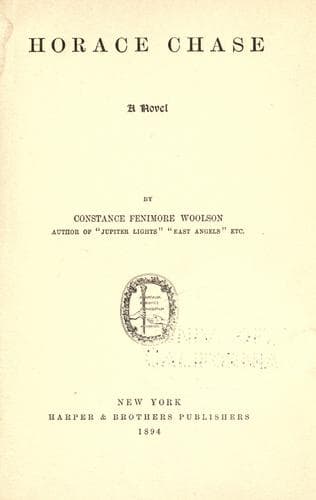
Didactic fiction; Men -- United States -- Fiction; United States -- Social life and customs -- 19th century -- Fiction
Time passed; the days grew slowly to months, and the months at last
became a long year, and then two. Little by little she fell back into
her old ways; she laughed at Dolly's sallies, she talked and jested with
her husband. She sometimes asked herself whether those buried feelings
would ever rise and take possession of her again. But Walter remained
absent--that was the thing that saved her. A personal presence was with
her always a powerful influence. But an absence was equally powerful in
its quieting effect; it produced temporarily more or less oblivion. She
had never been able to live on memories. And she had a great desire at
all times to be happy. And, therefore, to a certain degree, she did
become happy again; she amused herself with fair success at Newport and
New York.
And then Walter had re-entered the circle of her life. And by a fatality
this had come to her at St. Augustine. On the morning of the day of the
Grant reception, she had suddenly learned that he was in town. And she
knew (it came like a wave over her) that she dreaded the meeting.
There had been no spoken confidences between the sisters. But Dolly had
instantly extended all the protection that was in her power, and even
more; for she had braved the displeasure of her brother-in-law by
maintaining that his wife was ill, and that she (Dolly) knew more of the
illness than he did. And then, suddenly, this elder sister was put in
the wrong. For Ruth herself appeared, declaring gayly that she was well,
perfectly well. The gayety was assumed. But the declaration that she was
well was a truthful one; she was not only well, but her heart was
beating with excitement. For the idea had taken possession of her that
this was the very opportunity she needed to prove to herself (and to
Dolly also) that she was changed, that she was calm and indifferent. And
it would be a triumph also to show this indifference to Walter. Her
acts, her words, her every intonation should make this clear to him;
delightfully, coldly, brilliantly clear!
Yet, into this very courage had come, as an opposing force, that vague
premonition which had made her suddenly begin to sing "The Stirrup Cup."
But a mood of renewed gayety had followed; she had entered the
improvised ball-room with pulses beating high, sure that all was well.
Before the evening was over she knew that all was ill; she knew that at
the bottom of everything what had made her go thither was simply the
desire to see Walter Willoughby once more.
Public-domain text, read in full here on John Shaqi.
Reviews
Reviews
No reviews yet
Be the first to share your thoughts on this work.
Elsewhere in the archive
Join the Discussion
Join the discussion
Sign in to leave a comment or review.
Sign InorCreate an account