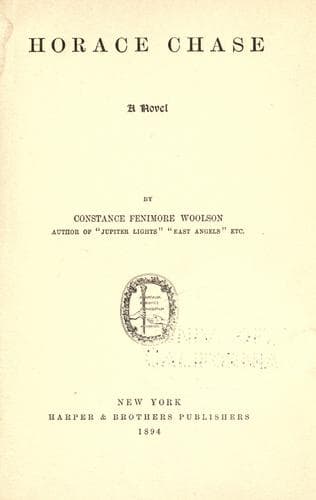
Didactic fiction; Men -- United States -- Fiction; United States -- Social life and customs -- 19th century -- Fiction
Big Moose, on his way home later (in his clergyman's attire this time),
was so happy that he gave thanks. He would have liked, indeed, to chant
a gloria. For the Mission was very near his heart, and from its
beginning it had been so painfully fettered by poverty that, several
times, he had almost despaired. But now that magic hat had brought to
the struggling little fund more than it had ever dreamed of possessing;
for underneath the dimes and the quarters of Asheville had laid a fat
roll, a veritable Golconda roll of greenbacks. But one person could have
given this roll, namely, the one stranger, Horace Chase.
CHAPTER III
Mrs. Franklin was a widow, her husband, Jared Franklin, having died in
1860. Franklin, a handsome, hearty man, who had enjoyed every day of his
life, had owned and edited a well-known newspaper in one of the large
towns on the Hudson River. This paper had brought him in a good income,
which he had spent in his liberal way, year after year. The Franklins
were not extravagant; but they lived generously, and they all had what
they wanted. Their days went on happily, for they were fond of each
other, they had the same sense of humor, and they took life easily, one
and all. But when Jared Franklin died (after a sudden and short
illness), it was found that he at least had taken it too easily; for he
had laid aside nothing, and there were large debts to pay. As he had put
his only son, the younger Jared, into the navy, the newspaper was sold.
But it did not bring in so much as was expected, and the executors were
forced in the end to sell the residence also; when the estate was
finally cleared, the widow found herself left with no home, and, for
income, only the small sum which had come to her from her father, Major
Seymour, of the army. In this condition of things her thoughts turned
towards the South.
For her mother, Mrs. Seymour, was a Southerner of Huguenot descent, one
of the L'Hommedieu family. And Mrs. Seymour's eldest sister, Miss Dora
L'Hommedieu, had bequeathed to the niece (now Mrs. Franklin), who had
been named after her, all she had to leave. This was not much. But the
queer, obstinate old woman did own two houses, one for the summer among
the mountains of North Carolina, one for the winter in Florida. For she
believed that she owed her remarkable health and longevity to a careful
change of climate twice each year; and, accompanied by an old negress as
cross-grained as herself, she had arrived in turn at each of these
residences for so many seasons that it had seemed as if she would
continue to arrive forever. In 1859, however, her migrations ceased.
Public-domain text, read in full here on John Shaqi.
Reviews
Reviews
No reviews yet
Be the first to share your thoughts on this work.
Join the Discussion
Join the discussion
Sign in to leave a comment or review.
Sign InorCreate an account