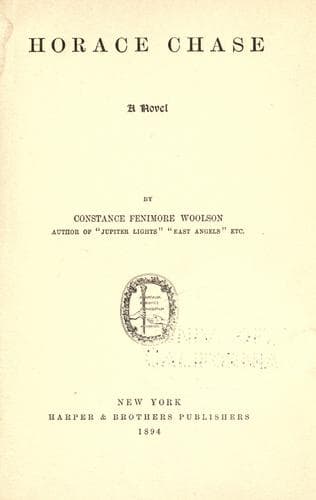
Didactic fiction; Men -- United States -- Fiction; United States -- Social life and customs -- 19th century -- Fiction
"You need not quote Ruskin to me--a man who criticises sculpture without
any practical knowledge whatever of human anatomy; a man who
subordinates correct drawing in a picture to the virtuous state of mind
of the artist! If Ruskin's theory is true, very good persons who visit
the poor and go to church, are, if they dabble in water-colors, or
pen-and-ink sketches, the greatest of artists, because their piety is
sincere. And _vice versa_. The history of art shows that, doesn't it?"
commented Maud, ironically. "I am sorry to see that you sat up so late
last night, Wilhelmina."
"Why, how do you know?" said Miss Billy, guiltily conscious of midnight
reading.
"By the deep line between your eyebrows. You must see to that, or you
will be misjudged by scientific minds. For marked, lined, or wrinkled
foreheads indicate criminal tendencies; the statistics of prisons prove
it. To-night put on two pieces of strong sticking-plaster at the
temples, to draw the skin back. The other thing I had to tell you is
that the result of my inquiries of a friend at the North who keeps in
touch with the latest investigations of Liebeault and the Germans, is,
that there may, after all, be something in the subject you mentioned to
me, namely, the possibility of influencing a person, not present, by
means of an effort of will. So we will try it now--for five minutes. Fix
your eyes steadily upon that figure of the carpet, Wilhelmina"--she
indicated a figure with her parasol--"and I will do the same. As subject
we will take my sister-in-law. We will will her to whip the twins. Are
you ready?" She took out her watch. "Begin, then."
Miss Billy, though secretly disappointed in the choice of subject, tried
hard to fix her mind upon the proposed castigation. But in spite of her
efforts her thoughts would stray to the carpet itself, to the pattern of
the figure, and its reds and greens.
"Time's up," announced Maud, replacing her watch in the strong
watch-pocket on the outside of her skirt; "I'll tell you whether the
whipping comes off. Do you think it is decent, Wilhelmina, to be
dressing and undressing yourself whenever you wish to know what time it
is?" (For Miss Billy, who tried to follow the fashions to some extent,
was putting her own watch back in her bodice, which she had unbuttoned
for the purpose.) "Woman will never be the equal of man until she has
grasped the conception that the position of her pockets should be
unchangeable," Maud went on.
"I think I will go with you as far as L'Hommedieu," suggested Billy,
ignoring the subject of the watch-pocket (an old one). "I have some
books to take, so I may as well." She put on her hat, and piled eight
dilapidated paper-covered volumes on her arm.
Public-domain text, read in full here on John Shaqi.
Reviews
Reviews
No reviews yet
Be the first to share your thoughts on this work.
Join the Discussion
Join the discussion
Sign in to leave a comment or review.
Sign InorCreate an account