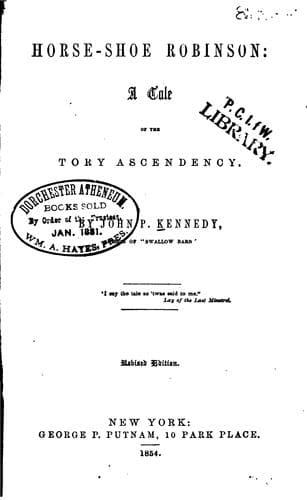
Horse-Shoe Robinson: A Tale of the Tory AscendencyKennedy, John Pendleton
History
Horse-Shoe Robinson: A Tale of the Tory Ascendency
Kennedy, John Pendleton
South Carolina -- History -- Revolution, 1775-1783 -- Fiction
The noise at this place brought together the rest of the hunters, who
were now returning with the buck thrown across a horse that had been led
by one of the party. Blake's wound was examined by them, and some linen
applied to staunch the blood. The man had fainted, but it was not
ascertained whether the stab was mortal. Habershaw stood sullenly
looking on during the examination, and, finding that life had not
instantly fled, he coolly wiped his knife and restored it to his girdle.
"The fellow has no idea of dying," he said with a visible concern, "and
has got no more than he deserves. He will live to be hung yet. Take him
to quarters."
"Make a hurdle for him," said one of the bystanders, and, accordingly,
two men cut a few branches from the neighboring wood, and twisting them
together, soon constructed a litter upon which they were able to bear
the body of the wounded hunter to the rendezvous. The others, scarcely
uttering a word as they marched along, followed slowly with the buck,
and in half an hour the troop was once more assembled under the
chestnut.
For a time there was a sullen and discontented silence amongst the whole
crew, that was only broken by the groans of the wounded trooper.
Occasionally there was a slight outburst of sedition from several of the
troop, as a sharper scream, indicating some sudden increase of pain,
from Gideon Blake, assailed their ears. Then there were low and muttered
curses pronounced by Habershaw, in a tone that showed his apprehension
of some vengeance against himself; and these imprecations were mingled
with hints of the disloyalty of the trooper, and charges of a pretended
purpose to betray his fellow-soldiers, evidently insinuated by the
captain to excuse his act of violence. Then he approached the sick man
and felt his pulse, and examined his wound, and pronounced the hurt to
be trifling. "It will do him good," he said, with affected unconcern,
"and teach him to be more true to his comrades hereafter." But still the
fate of the man was manifestly doubtful, and the rising exasperation of
the troop became every instant more open. Alarmed and faint-hearted at
these symptoms of discontent, Habershaw at last called the men into a
circle and made them a speech, in which he expressed his sorrow for the
act he had committed, endeavored to excuse himself by the plea of
passion at the loss of his dog, and, finally, perceiving that these
excuses did not satisfy his hearers, acknowledged his drunken condition
and his unconsciousness of the deed he had done until the horrible
consequences of it were before his eyes. Here Peppercorn interposed in
his favor, alleging that he had examined the wound, and that, in his
opinion, the trooper's life was not in danger.
"And as the captain is sorry for it, lads," he concluded, "why, what is
to be done but let the thing drop? So, if there's another canteen in the
squad, we will wet our whistles, boys, and go to sleep."
Public-domain text, read in full here on John Shaqi.
Reviews
Reviews
No reviews yet
Be the first to share your thoughts on this work.
Elsewhere in the archive
Join the Discussion
Join the discussion
Sign in to leave a comment or review.
Sign InorCreate an account