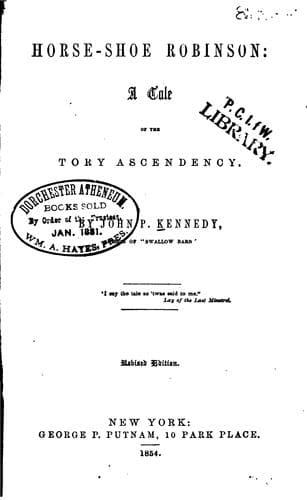
Horse-Shoe Robinson: A Tale of the Tory AscendencyKennedy, John Pendleton
History
Horse-Shoe Robinson: A Tale of the Tory Ascendency
Kennedy, John Pendleton
South Carolina -- History -- Revolution, 1775-1783 -- Fiction
This appeal was effectual, and was followed by a hearty cheer. So,
draining the dregs of the last flask, this debauched company retired to
rest--Habershaw sneaking away from them with a heart loaded with malice
and revenge.
A few men were employed, for a short time, in burying the bodies of the
troopers who were killed in the fray; and, excepting the guard, who
busied themselves in skinning the buck and broiling some choice slices
before the fire, and in watching the prisoners, or attending upon their
sick comrade, all were sunk into silence if not repose.
CHAPTER XVIII.
THE TROOPERS MOVE WITH THEIR PRISONERS.
"Oft he that doth abide,
Is cause of his own paine,
But he that flieth in good tide,
Perhaps may fight again."--_Old Proverb._
It was with the most earnest solicitude that Butler and his companion
watched the course of events, and became acquainted with the character
of the ruffians into whose hands they had fallen. The presence of James
Curry in this gang excited a painful consciousness in the mind of the
soldier, that he had powerful and secret enemies at work against him,
but who they were was an impenetrable mystery. Then the lawless habits
of the people who had possession of him, gave rise to the most anxious
distrust as to his future fate: he might be murdered in a fit of
passion, or tortured with harsh treatment to gratify some concealed
malice. His position in the army was, it seemed, known too; and, for
aught that he could tell, his mission might be no secret to his captors.
Robinson's sagacity entered fully into these misgivings. He had narrowly
observed the conduct of the party who had made them prisoners, and with
that acute insight which was concealed under a rude and uneducated
exterior, but which was strongly marked in his actions, he had already
determined upon the course which the safety of Butler required him to
pursue. According to his view of their present difficulties it was
absolutely necessary that he should effect his escape, at whatever
personal hazard. Butler, he rightly conjectured, was the principal
object of the late ambuscade; that, for some unknown purpose, the
possession of this officer became important to those who had procured
the attack upon him, and that James Curry had merely hired this gang of
desperadoes to secure the prize. Under these circumstances, he concluded
that the Major would be so strictly guarded as to forbid all hope of
escape, and that any attempt by him to effect it would only be punished
by certain death. But, in regard to himself, his calculation was
different. "First," said he, "I can master any three of this beggarly
crew in an open field and fair fight; and, secondly, when it comes to
the chances of a pell-mell, they will not think me of so much account as
to risk their necks by a long chase; their whole eyes would undoubtedly
be directed to the Major." The sergeant, therefore, determined to make
Public-domain text, read in full here on John Shaqi.
Reviews
Reviews
No reviews yet
Be the first to share your thoughts on this work.
Elsewhere in the archive
Join the Discussion
Join the discussion
Sign in to leave a comment or review.
Sign InorCreate an account