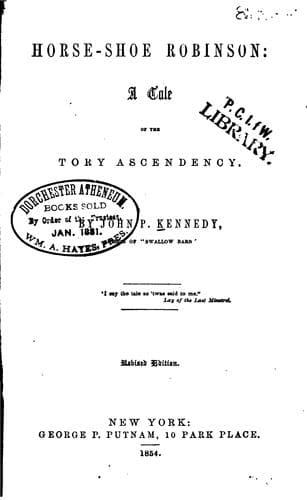
Horse-Shoe Robinson: A Tale of the Tory AscendencyKennedy, John Pendleton
History
Horse-Shoe Robinson: A Tale of the Tory Ascendency
Kennedy, John Pendleton
South Carolina -- History -- Revolution, 1775-1783 -- Fiction
"That we pause to inquire," replied Innis, "is a boon of mercy to you.
The offence of rank rebellion which you and all your fellow-madmen have
confessed, by taking up arms against your king, carries with it the last
degree of punishment. If, waiving our right to inflict summary pain for
this transgression, we stay to hear what you can say against other and
even weightier charges, you should thank us for our clemency. But this
is misspending time. Read the paper to the prisoner," he added,
addressing one of the officers at the table.
The paper was read aloud. It first presented a charge against the
prisoner for violating the terms of the parole given at the capitulation
of Charleston. The specification to support this charge was that, by the
terms of the surrender, General Lincoln had engaged that the whole
garrison should be surrendered as prisoners of war, and that they should
not serve again until exchanged. The prisoner was described as an
officer of that garrison, included in the surrender, and lately taken in
the act of making war upon his majesty's subjects.
The second charge was, that the prisoner had insinuated himself, by
false representations, into the territory conquered by the royal army;
and that, in the quality of a spy, he had visited the family of a
certain Walter Adair, with a view to obtain a knowledge of the forces,
plans, movements, and designs of the various detachments engaged in his
majesty's service in the neighborhood of Broad River.
And, third and last, that he, together with certain confederates, had
contrived and partially attempted to execute a plan to seize upon and
carry away a subject of his majesty's government, of great consideration
and esteem--Mr. Philip Lindsay, namely, of the Dove Cote, in the
province of Virginia. That the object of this enterprise was to possess
himself of the papers as well as of the person of the said Philip
Lindsay, and, by surrendering him up to the leaders of the rebel army,
to bring upon him the vengeance of the rebel government, thus exposing
him to confiscation of property, and even to peril of life.
Such was the general import and bearing of the accusations against the
prisoner, expressed with the usual abundance of verbiage and minuteness
of detail. Butler listened to them, at first, with indifference, and
with a determination to meet them with inflexible silence; but, as the
enunciation of them proceeded, and the extraordinary misrepresentations
they contained were successively disclosed, he found his indignation
rising to a height that almost mastered his discretion, and he was on
the point of interrupting the court with the lie direct, and of
involving himself in an act of contumacy which would have been instantly
decisive of his fate. His better genius, however, prevailed, and,
smothering his anger by a strong effort of self-control, he merely
folded his arms and abided until the end, with a contemptuous and proud
glance at his accusers.
Public-domain text, read in full here on John Shaqi.
Reviews
Reviews
No reviews yet
Be the first to share your thoughts on this work.
Elsewhere in the archive
Join the Discussion
Join the discussion
Sign in to leave a comment or review.
Sign InorCreate an account