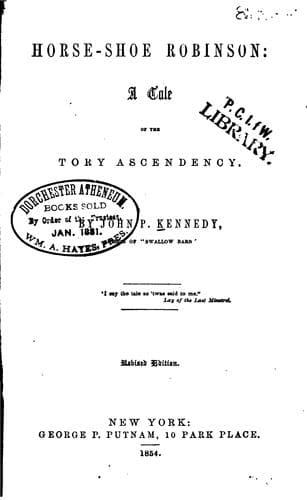
Horse-Shoe Robinson: A Tale of the Tory AscendencyKennedy, John Pendleton
History
Horse-Shoe Robinson: A Tale of the Tory Ascendency
Kennedy, John Pendleton
South Carolina -- History -- Revolution, 1775-1783 -- Fiction
"You have heard the allegations against you, sir," said Colonel Innis;
"what say you to them?"
"What should an honorable man," replied Butler, "say to such foul
aspersions? The first and second charges, sir, I pronounce to be
frivolous and false. As to the last, sir, there are imputations in it
that mark the agency of a concealed enemy, lost to every impulse of
honor--a base and wicked liar. Confront me with that man, and let the
issue stand on this--if I do not prove him to be, in the judgment of
every true gentleman of your army, an atrocious and depraved slanderer,
who has contrived against my life for selfish purposes, I will submit
myself to whatever penalty the most exasperated of my enemies may
invent. It was my purpose, sir, to remain silent, and to refuse, by any
act of mine, to acknowledge the violation of the rights of war by which
I have been dragged hither. Nothing could have swayed me from that
determination, but the iniquitous falsehood conveyed in the last
accusation."
"We cannot bandy words with one in your condition," interrupted the
president of the court. "I must remind you again, that our purpose is to
give you a fair trial, not to listen to ebullitions of anger. Your honor
is concerned in these charges, and you will best consult your interest
by a patient demeanor in your present difficulties."
"I am silent," said Butler, indignantly, taking his seat.
"Let the trial proceed," continued the president. "You will not deny,"
he said, after an interval of reflection, "that you are a native of
Carolina?"
"I can scarcely deny that before you," replied Butler, "who, in my
absence, as report says, have been busy in the investigation of my
affairs."
"There are bounds, sir, to the forbearance of a court," said Innis,
sternly. "I understand the taunt. Your estates have been the subject of
consideration before another tribunal; and if my advice were listened
to, the process relating to them would be a short one."
"You are answered," returned Butler.
"Nor can you deny that you were an officer belonging to the army under
the command of General Lincoln."
Butler was silent.
"You were at Charleston during the siege?" inquired one of the court.
"In part," replied Butler. "I left it in March, the bearer of despatches
to Congress."
"And you were in arms on the night of the thirteenth, at Grindall's
Ford?" continued the same questioner.
"I confess it, sir."
"That's enough," interrupted Innis. "In the ninth article of the
capitulation of Charleston we read: 'all civil officers, and the
citizens who have borne arms _during the siege_, must be prisoners on
parole.'"
"I should say," interposed St. Jermyn, who now, for the first time,
opened his lips, "that the prisoner scarcely falls within that
description. The words 'during the siege' would seem to point to a
service which lasted to the end. They are, at least, equivocal; and I
doubt Lord Cornwallis would be loath to sanction a judgment on such a
ground."
Public-domain text, read in full here on John Shaqi.
Reviews
Reviews
No reviews yet
Be the first to share your thoughts on this work.
Elsewhere in the archive
Join the Discussion
Join the discussion
Sign in to leave a comment or review.
Sign InorCreate an account