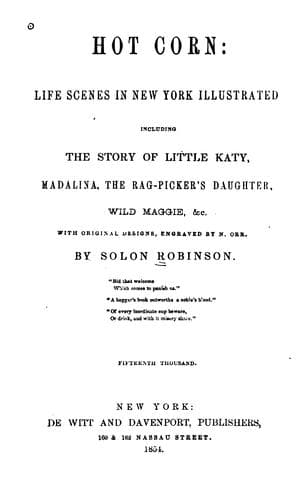
Hot corn: Life Scenes in New York IllustratedRobinson, Solon
General
Hot corn: Life Scenes in New York Illustrated
Robinson, Solon
New York (N.Y.) -- Social life and customs -- 19th century -- Fiction; Temperance -- Fiction
She did run with her great load, till she almost dropped under its
overwhelming weight. Why should she thus labor--thus expend so much
strength to so little purpose? She knew no other way to live. Nobody
gave her remunerative labor for strong hands; nobody took those two
stout boys, and set them to till the earth, or taught them how to create
bread, and yet they must eat, and so they prowl about the pulled-down
houses, snatching everything they can carry away--a sort of permitted
petty larceny, that teaches those who practice it how to do bigger
deeds; and those old timbers they split up into kindling wood and peddle
through the streets.
Poor uncared for fellow creatures; working and stealing to escape
starvation--living, for what?--running to escape being run over by an
unfeeling driver who cared just as much for them as for so many dogs.
On they went, down Anthony street; and I followed, determined to see the
_home_ of this portion of the city poor. It was but one block
further--only one little space beyond this great, wide, open, railroad
street, whose thoughtless thousands daily go up and down from homes of
wealth to wealth-producing ships and stores, little thinking of the
amount of human misery within a stone's throw of the rails on which they
glide swiftly along.
One block further, and the street opens into a little, half acre sort of
triangular space, sometimes dignified with the name of "park," but why,
those who know can only tell, for it has no fence, no grass, and but a
dozen miserable trees; 'tis lumbered up with carts and piles of stones,
and strings of drying clothes, and scores of unwashed specimens of young
humanity, whose home is in the dirt, whether in the street or parents'
domicil.
Here let us stop and look around. A very short street, only one block
across the base of the "park," runs to the right from where we stand,
past the "Five Points House of Industry," to Cross street. This is the
most notorious little street in New York. Its name is Little Water
street. It lead from the "Old Brewery" to "Cow Bay." Who that has lived
long in this city, or read its history, particularly that portion of it
written by Dickens, has not heard of the "Old Brewery?" It is not there
now. That awful den of crime, poverty, and wretched drunken misery has
been pulled down, and in its place a substantial brick edifice, in
which is a chapel and school-room, and home of another missionary, has
been erected by the noble, generous efforts of the Ladies' Home
Missionary Society, of the Methodist Church. The old tenants have been
driven out or reformed. How different, too, are the present occupants of
that large brick pile in Little Water street, from those who filled its
numerous rooms before the missionary came there. Every room was a
brothel or a den of thieves, or both combined. Now it is a house of
prayer--a home for the homeless--a place of refuge for midnight
wandering little beggar girls.
Public-domain text, read in full here on John Shaqi.
Reviews
Reviews
No reviews yet
Be the first to share your thoughts on this work.
Elsewhere in the archive
Join the Discussion
Join the discussion
Sign in to leave a comment or review.
Sign InorCreate an account