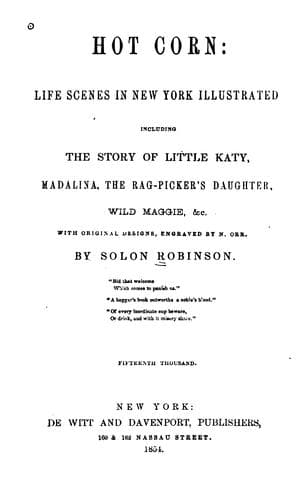
Hot corn: Life Scenes in New York IllustratedRobinson, Solon
General
Hot corn: Life Scenes in New York Illustrated
Robinson, Solon
New York (N.Y.) -- Social life and customs -- 19th century -- Fiction; Temperance -- Fiction
Before us lies the misnamed, neglected triangle, called a park. At the
further end is the frame house that we see so plainly as we look down
Anthony street from Broadway. At the left, as though it were a
continuation of Little Water street, lies that notorious Five Points
collection of dens of misery, Cow Bay. It is a _cul-de-sac_, perhaps
thirty feet wide at the mouth, narrowing, with crooked, uneven lines,
back to a point about a hundred feet from the entrance. Into this court
I tracked the kindling-wood-splitters, and threaded my way among the
throng of carts and piles of steaming garbage; elbowing my way along the
narrow side-walk, and up a flight of broken, almost impassable steps, I
reached the first floor hall of one of the houses, just in time to see
that great load of wood and its bearer toiling up a narrow, dark, broken
stairway, which I essayed to climb; but just then, from the room on the
left, at the foot of the stairs, there came such a piercing,
murder-telling, woman's shriek, that I started back, grasped my stout
cane, determined to brave the worst for the rescue, made one step,
pushed open the door, creaking with a horrid grating upon its rusty
hinges, and stood in the presence of an Eve, before the fall, in point
of clothing, but long, long after that in point of sin. As I entered the
open door, she sprung towards it; her husband caught her by the hair,
and drew her back, with no gentle hand or word.
"Let me go, let me go--help!--he wants to murder me; let me go--help,
help, help!"
I did help, but it was help to the poor man, for she turned upon him
with the fury of a tiger, scratching and tearing his face and clothes,
and then settling with a grasp upon his throat, which produced the
death-rattle of suffocation.
A strong silk handkerchief served the hand-cuff's place, and to bind
hands and feet together; after which she lay quietly upon a little straw
and rags, in one corner, the only articles of furniture in the room,
except a bottle, broken cup, and something that looked as though it once
had been female apparel.
"Is this your wife?"
"She was."
"What is she now?"
"The devil's fury. You saw what she is."
"Do you live with her?"
"I did for seven years."
"Did she drink then?"
"Sometimes--not so bad."
"Did you drink?"
"Well, none to hurt. I kept a coffee house."
"And made your wife a drunkard. How came she reduced to this dreadful
condition? You are well dressed."
"I left her three months ago, and went West to find a place to move to.
She said if she could go where nobody knew her she would reform. I left
her in a comfortable room, with good furniture and good clothes. Now,
where are they? All gone to the pawnbroker's; the money gone for
rum--her virtue, shame, everything gone. How, what, and where do I find
her? As you see, crazy drunk, in this miserable hole, in Cow Bay. And my
boy, starved, made drunk, and--"
"What, have you a child by her, then?"
Public-domain text, read in full here on John Shaqi.
Reviews
Reviews
No reviews yet
Be the first to share your thoughts on this work.
Elsewhere in the archive
Join the Discussion
Join the discussion
Sign in to leave a comment or review.
Sign InorCreate an account