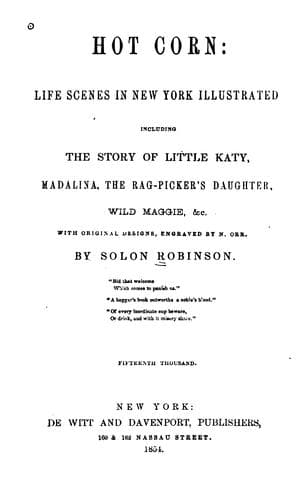
Hot corn: Life Scenes in New York IllustratedRobinson, Solon
General
Hot corn: Life Scenes in New York Illustrated
Robinson, Solon
New York (N.Y.) -- Social life and customs -- 19th century -- Fiction; Temperance -- Fiction
He had slipped in, with handkerchief over his face, just before Mrs.
Laylor went out. She told him that she was going to the railroad depot
to meet a young woman from the country, a dress-maker, whom she had sent
for, to come and make a few dresses for her and "my daughter," as she
unblushingly, called Nannette, who, she said, "had been away from home,
at school."
The words were true, yet the speech was a lie, a wicked lie, made to
deceive one who had been unwary enough to put his finger in a trap. She
had been away from home, a home where she left a mother, and brothers,
and sisters. And she had been at school--a school where language and
manners are taught; but, oh! what language, and what ways, and manners.
It is a school which is computed to have thirty thousand teachers in
this city.
What strange inconsistencies our human nature is possessed of. This
Nannette had naturally a good heart. We saw that in the scene where Mrs.
Morgan discovers the depth of depravity to which one of those teachers
had dragged down her husband. Yet, no sooner is Athalia placed by
misfortune in a position to be subject to temptation, than she offers
her gratuitous services to Mrs. Laylor, to effect her complete ruin.
What for? Who can answer? I cannot, unless the fable of the fox that
lost his tail in a trap, will give a cue to the solution. I fear, that
we are too apt to wish others no better than ourselves. It must have
been some such motive that actuated Nannette: the little pecuniary
advantage offered by Mrs. Laylor for her assistance, does not seem to be
a sufficient motive for one female, though she herself has lost the
priceless jewel of female virtue, to wish to bring another of her sex
into that vortex which engulfs all who come within its maeelstrom power,
as certain as that upon the Norway coast. Be the motive what it may, she
had certainly lent herself this day, as a willing tool, to do a double
deed of wrong.
I cannot name the clergyman who was to be made--had been made--the
victim in this nefarious plot, because he is still living, and has paid
the penalty of ruined health for visiting such a house, and a still
greater penalty of a gnawing conscience for the sin, and the lies told
to cover it up.
As a _nom de plume_, I will call him, Otis, because it is the most
dissimilar to his own, of any one I can think of.
Public-domain text, read in full here on John Shaqi.
Reviews
Reviews
No reviews yet
Be the first to share your thoughts on this work.
Elsewhere in the archive
Join the Discussion
Join the discussion
Sign in to leave a comment or review.
Sign InorCreate an account