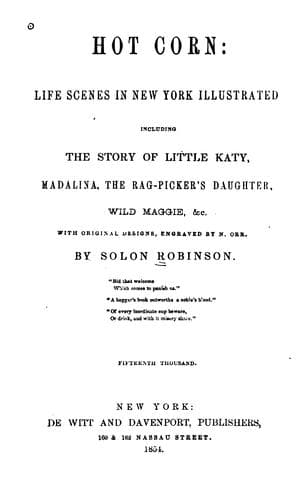
Hot corn: Life Scenes in New York IllustratedRobinson, Solon
General
Hot corn: Life Scenes in New York Illustrated
Robinson, Solon
New York (N.Y.) -- Social life and customs -- 19th century -- Fiction; Temperance -- Fiction
Otis had been tempted to visit this house, as I said before, by a
natural strong passion, but that would have been insufficient, had not a
sort of Paul Pry friend told him of the delinquency of one of his flock,
and urged him to watch him. He did so, saw him enter the house with a
woman, certainly not his wife, charged him afterwards, with a view to
his reformation, and was met with a plump denial of the character of
the place, and even threatened with exposure of his attempt to watch and
pry into other peoples' business. Goaded with such an accusation, he
retorted upon his informer, and he in his turn reiterated the charge,
and urged Otis to "call on a professional (that is pastoral) visit," and
satisfy himself.
This he did, and found the house most genteelly and richly furnished;
the owner, "a widow, living," she said, "upon the interest of money in
bank,"--she meant the interest of bankers' money--a very modest, genteel
lady, very much pleased to have him call, and begged him to repeat the
visit "some afternoon or evening when the young ladies, her nieces and
daughter, would be at home, and if he was fond of music, they would play
for him, and one of them could sing beautifully." She could sing the
"Mermaid's song." He was completely deceived. Who might not be by such a
siren? The truth is, that her penetrating eye had seen at a glance quite
down into his very secret thoughts, and that he possessed passions which
she could inflame and turn to account, and she laid all her plans to
that end. Although satisfied, after one or two visits, that all the
inmates of the house were correct, he had his suspicions aroused as to
those who visited them, for he could not help noticing the fact, that
while he was there one evening, there were no less than five calls,
apparently of couples, who were received in a dark hall, with whispered
words, and then went upstairs, and after awhile went out in the same
quiet way. Twice, he saw through the crack of the door that the ladies
were veiled with thick dark veils, such as we meet every day upon the
Broadway side-walk. But the most convincing thing of all, was an
incautious word spoken aloud by one of the visitors as Mrs. Laylor was
letting him out. He knew the voice. It was the man whose conduct had led
him first to this house. Then he was so well satisfied, that he told
Mrs. Laylor his suspicions, and she acknowledged that she did sometimes
let a room to a gentleman and lady, but to none except persons of the
highest respectability, such as himself, for instance. That was a cue.
He took it and fell into the snare. She agreed "for a consideration," to
introduce him to one of the most respectable ladies, upon the
understanding that she was to remain closely veiled,--as the whole
proceeding was to be veiled from the Argus eyes of the world.
Public-domain text, read in full here on John Shaqi.
Reviews
Reviews
No reviews yet
Be the first to share your thoughts on this work.
Elsewhere in the archive
Join the Discussion
Join the discussion
Sign in to leave a comment or review.
Sign InorCreate an account