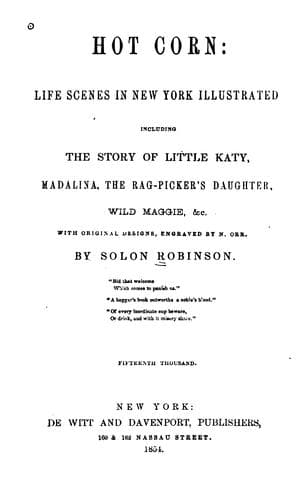
Hot corn: Life Scenes in New York IllustratedRobinson, Solon
General
Hot corn: Life Scenes in New York Illustrated
Robinson, Solon
New York (N.Y.) -- Social life and customs -- 19th century -- Fiction; Temperance -- Fiction
Frank was very kind to her in a certain measure. He liked her, but it
was a very selfish liking. He did not like to hear her talk about
leaving. He liked her there, and he was almost as much her jailer as
Mrs. Laylor. He took her out to all manner of dissipation, theatres,
saloons, late suppers, balls and frolics, in which strong drink--not
Athalia Morgan--acted as wild a part as the wildest. But he offered her
no means of escape. She began to have a sort of fondness for Frank. What
woman can avoid liking one who is devoted to her? But this devotion to
one was not what Mrs. Laylor wished. It was not what brought the most
money to her iron chest. She would like to negotiate the charms of
Athalia to some rich libertine every day, whenever she could meet with
one fool enough to pay her well for her influence with the "young
widow."
Among the most determined of her suitors, was a young Frenchman, who
used every art which he knew well how to use with words and money, to
win Athalia's favor. As a last resort, he pledged a splendid diamond
ring to Mrs. Laylor, if she would accomplish what he could not.
When all other arts fail to work ruin and misery in a woman's mind,
there is one left, one which concentrates all the power of all the lies
of the father of deception. It is jealousy.
There is a little story in "Othello," about the arts of a villain, to
produce mischief by that power. It is nothing compared with the villainy
and lies invented to produce jealousy between Frank and Athalia, so as
to let in the Frenchman, and win that ring.
Villainy is too often successful in this life. It was in this case.
Jealousy, a feeling of revenge, drives more women to infidelity towards
those they love, than all other causes.
It did its perfect work with Athalia, and then the fiend who had
accomplished the work, laughed at her, and told her how she had been
fooled, thinking it would have the usual effect, to make her careless of
what she did in future. It had an entirely different effect upon
Athalia. It was this that produced the state of mind that Adelaide
called the dumps, the blues, and the tears that Stella saw her shed.
Stella had told her mother much that Athalia told her, much that the
child did not understand, but the mother did, for she knew how girls
were inveigled into those houses, and kept there as prisoners.
I have lately witnessed a scene, highly illustrative of this fact. It is
one of the "Life Scenes of New York."
Public-domain text, read in full here on John Shaqi.
Reviews
Reviews
No reviews yet
Be the first to share your thoughts on this work.
Elsewhere in the archive
Join the Discussion
Join the discussion
Sign in to leave a comment or review.
Sign InorCreate an account