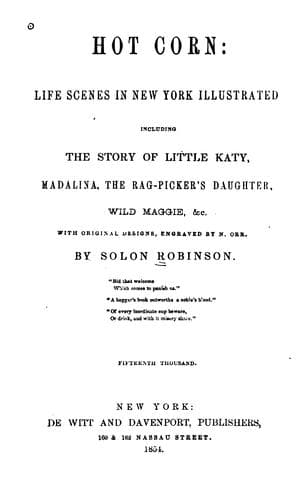
Hot corn: Life Scenes in New York IllustratedRobinson, Solon
General
Hot corn: Life Scenes in New York Illustrated
Robinson, Solon
New York (N.Y.) -- Social life and customs -- 19th century -- Fiction; Temperance -- Fiction
Coming up one of the streets west of Broadway, about one o'clock at
night, I saw a fellow hovering near a house, whom I recognized as a
Negro wood-sawyer that I had seen the day before, engaged at the same
house, putting wood down the cellar grate. I knew him or thought I did,
as a poor but honest man, and I felt pained with a fear that I had been
deceived, that he had left the grate unfastened, and now was about to
steal something from the cellar. I passed on around the next corner, out
of sight, and then turned back and crossed over, where I could have a
full view of his operations. There were no lamps burning, because there
should, or might have been moonlight, if it had been clear; as it was,
it was a fitting time for the burglar's trade. Directly, the fellow
approached the grate, opened it carefully, and drew up a trunk. My heart
beat with excitement, fear, and sorrow. I was just on the point of
calling, "Watch," I must own with a view of letting the fellow escape,
and saving the trunk, when I saw a bonnet, then a shawl, and then a full
suit of woman's clothes follow the trunk up from that dark recess. My
mind was somewhat relieved; my honest wood-sawyer might be honest still,
though he was probably assisting a dishonest woman; else why did she
leave that house, to all appearance, an honest house, for all that I had
ever seen in passing it a hundred times, in such a clandestine manner.
The Negro walked on with the trunk on his shoulder, and the woman
followed. It was a scene of such frequent occurrence, that it would
excite no suspicion or question from a policeman. He would think it was
a passenger by the train, from Boston, or Albany, or the Erie railroad,
all of which make midnight arrivals.
On they went, block after block, and I followed, till I thought the
chase likely to prove a long one, and then I stepped up to the woman,
and laying my hand upon her shoulder, said, "Stop!" She uttered a little
cry of alarm, and said, "Oh, don't take me up, please don't."
The Negro stopped, looked round, and set down the trunk hastily,
evidently supposing that a star had nabbed her, and that the better part
of a fight consists in running away. There was a light here, for the
lamp-lighters were just going their late rounds. He gave one glance back
before he started, to be sure he had good cause to run, and instantly
burst into a most merry fit of laughter, very unlike what might be
supposed that of a caught burglar.
[Illustration: "'SPEC A BODY HAS A RIGHT TO STEAL OWN TRUNK."--_Page
285._]
"Ha! ha! ha! ki, missee, you don't know dat gemman? You nebber seed dat
gemman 'fore? You tink him a star? Look at um. You tink he look so he
hurt you? He wouldn't hurt a child, much more a woman. I know dat
gemman. Ki, I mighty glad to see him. 'Spose tell him all about um? Spec
he say a body has a right to steal he own trunk, and run away from such
a house as dat."
"Such a house as that, Peter; is that not a good house?"
Public-domain text, read in full here on John Shaqi.
Reviews
Reviews
No reviews yet
Be the first to share your thoughts on this work.
Elsewhere in the archive
Join the Discussion
Join the discussion
Sign in to leave a comment or review.
Sign InorCreate an account