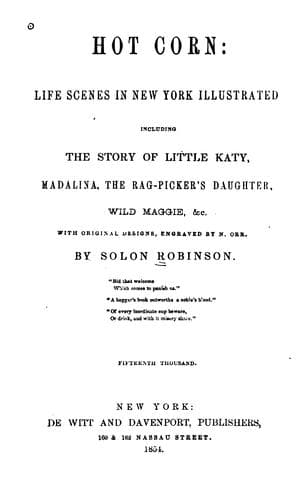
Hot corn: Life Scenes in New York IllustratedRobinson, Solon
General
Hot corn: Life Scenes in New York Illustrated
Robinson, Solon
New York (N.Y.) -- Social life and customs -- 19th century -- Fiction; Temperance -- Fiction
"Villain, black-hearted villain; who laid his snares for a poor,
simple-hearted girl, to work her ruin. I wonder that you ever got away,
ever got out of that house. How did you do it?"
"When I came to a little, I ran down stairs as fast as I could go, and
he ran after me, and cried, 'Stop her,' and two other women ran out in
the hall to do it, but just then the door was opened, and two gentlemen
were going out, and I ran right into the arms of one of them, and he
carried me clear out, in spite of them, and then the other one said,
'Let her go, she is drunk--now run.' I did run and they hallooed, and
then the boys took after me, and, oh, dear, you know the rest."
CHAPTER XVII.
THE INTELLIGENCE OFFICE.--AGNES.
"All things are pure to those who are pure."
"Wisdom and goodness to the vile seem vile."
Perhaps some of my readers have been sufficiently interested to inquire,
"Who is Agnes, and what of her?" Perhaps there may be some, who, like
Mrs. McTravers, think she is not a proper character to introduce into a
respectable family, coming as she did from a house which gives an air of
taint, spoiled, lost, ruined, to every character that is found within
its walls. I am aware that there is room for suspicion, but suspicion is
not proof. In the case of Athalia, her acknowledged sin is no more proof
of moral turpitude than any other act of a deranged mind. A lunatic may
kill, yet it is not murder. A drunken husband may beat his loving wife,
and love her still. It was not the man who struck the blow, it was the
demon Rum! It was not Athalia who lost her virtue, it was the worse than
demon who robbed her--intoxicated her--destroyed her reason--enslaved
her mind--but he did not, could not, destroy her virtuous, benevolent
heart. Her conduct toward Agnes, is alone sufficient to prove this. And
if she had known as much as I did of Agnes, that there might be some
ground of suspicion against her, it would have made no odds; she would
have taken her in and taken care of her in the same way, if she had
known that she was a great sinner; that is the true way to work
reformation; and then she would have said, "Go, daughter, and sin no
more."
But she knew nothing against Agnes; even after I had told her of the
trunk, she said, all may yet be right. She was unwilling to believe that
all was wrong. How triumphantly she met me as I came home in the
evening--how a woman does love to triumph over us in a good cause,
proving herself what she is in all the purest qualities of the
heart,--our superior.
Public-domain text, read in full here on John Shaqi.
Reviews
Reviews
No reviews yet
Be the first to share your thoughts on this work.
Elsewhere in the archive
Join the Discussion
Join the discussion
Sign in to leave a comment or review.
Sign InorCreate an account