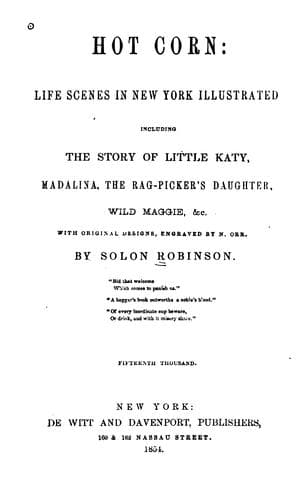
Hot corn: Life Scenes in New York IllustratedRobinson, Solon
General
Hot corn: Life Scenes in New York Illustrated
Robinson, Solon
New York (N.Y.) -- Social life and customs -- 19th century -- Fiction; Temperance -- Fiction
"I told you so," said Athalia. "I knew there had been some base
deception, some wickedness practiced towards that poor girl to inveigle
her into that house. Come up stairs, and you shall hear her story from
her own lips; she is quite smart now, and able to sit up and talk, and
looks so pretty--she is pretty, and that has been the great cause of her
trouble. But she is a good girl; I have heard a good deal about her
to-day, besides what she has told me. Phebe and Peter, have both been
here, and such a meeting, oh! it would have done your heart good to have
been here, and to see these poor blacks' conduct towards this girl,
after I had told them the story of her adventures last evening: they
hugged her, and kissed her with as much affection as though she had been
one of their own; and then Peter went to see the lady where she had been
living, at the place he got for her, the next day after your first
interview with her, and the lady was terribly alarmed about the poor
girl, and so she would not let Peter come back until she had the
carriage up, and then she took him in--only to think, such a sweet,
nice, pretty lady did not feel herself in the least disgraced to ride
with a poor, old, negro wood-sawyer in her fine carriage, to visit a
poor sick servant girl. And so she came, and such a time! why, if she
had been her own child, she could not have been more affectionate. And
then Agnes told us her story, and then I told Mrs. Meltrand, that is her
name, about Mrs. De Vrai, and how that same man, who treated Agnes so
badly, tried to steal Mrs. De Vrai's little girl, and then she said,
'how singular,' and then of course I said, what is so singular?"
"Ah me, it is a long story, and would not interest you, but I was robbed
of a dear little girl, fifteen years ago, in England, by just such a
man, in just the same way, but it could not have been this man, his name
was Brentnall."
"Brentnall, why that is my name," said Agnes.
"Your name, why you never told me that before."
"No, ma'am, you never asked me, and I did not suppose that you cared to
know anything about me, only that I was a good girl, and did your work
well, and answered to the name of Agnes."
True. How little interest we all take in our servants; they come and go
and we never know that they have any name but one that is most
convenient to call them by, and we take no interest in them, hardly
enough to know that they possess souls as precious as our own.
"And so, your name is Brentnall, what was your father's name?"
"I don't know, ma'am, as I ever had any, or mother either."
"But you must have had both."
"Oh yes, I suppose I must, to have been born, but I mean I never saw
any."
"Where did you live, and who brought you up?"
"I lived with an uncle, near Belfast, and came over with him and his
family, and every one of them died of ship fever on the voyage, and when
I landed here in this great city, I was utterly alone, and almost
penniless. Oh dear!"
Public-domain text, read in full here on John Shaqi.
Reviews
Reviews
No reviews yet
Be the first to share your thoughts on this work.
Elsewhere in the archive
Join the Discussion
Join the discussion
Sign in to leave a comment or review.
Sign InorCreate an account