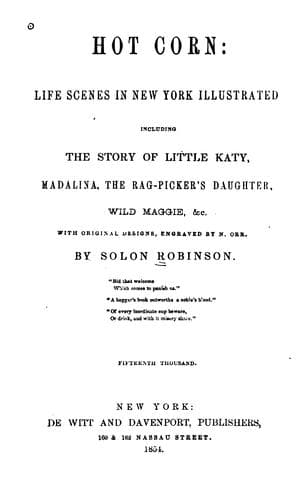
Hot corn: Life Scenes in New York IllustratedRobinson, Solon
General
Hot corn: Life Scenes in New York Illustrated
Robinson, Solon
New York (N.Y.) -- Social life and customs -- 19th century -- Fiction; Temperance -- Fiction
"And then Mrs. Meltrand, said, 'Oh dear,' and she went away feeling sad.
I do wish I knew what it could be in that name that made her feel so
sad. Some reminiscence connected with the loss of her little girl, I
suppose. It is very sad, to lose a child by death, it must be very much
more sad to have one stolen away, and never know what becomes of it,
whether dead or alive; and if the mother should meet her own child in
the street not to know it; but dear me, how I am running on while you
are eating your supper, as though you had nothing to think of but the
things that interest me so much. But if you have been able to eat while
I have been talking, come up to my room and see my protege and hear her
story."
So we went up, and found the invalid almost recovered, looking so sweet,
for she looked grateful, and that, when it beams out like the sunlight,
will make any face look beautiful.
"I told you," said Mrs. Morgan, "about her landing here penniless and
alone, and I want she should tell you--there now, there is the bell, how
I do hope that is uncle--yes it is--it is; do you hear him talking to
Bridget? that is his step, now--"
Now the door opens, and now she is in his arms, and now there are more
questions than answers:--
"When did he arrive? How did he find things out West? Has he been to
supper? What is the news?"
"Now you are a perfect woman, you are enough to confuse a whirlwind. Sit
down, and be quiet, and I will tell you all that you need to know. But
first tell me who is this young lady; you forgot to introduce me."
"So I did, but of course she knows by this time that you are my uncle,
and you will know directly all about her, for she was just going to tell
part of her story, and I shall tell the rest before you go to bed."
"I will warrant that. Perhaps you would like to hear mine, and where I
have been since I arrived."
"Yes, indeed, do tell me, and why you did not come right home?"
"I have been to jail, since I arrived; locked up in the criminal cells.
It is a little singular too, how I got there. It is all owing to the
newspapers."
"Owing to the newspapers, uncle, I do not understand how the papers
should get you in prison."
"Very well I do. I saw an item in one of them this evening, about the
arrest of a person whose name struck me very forcibly as being that of a
man whom I once knew in Europe, and who I was very anxious to see, for I
felt the deepest interest to know what had become of his wife. For him
I cared nothing, I knew he was a villain, and felt rejoiced to think he
had met his deserts at last; but his wife was a sweet good woman, a
victim of unfortunate circumstances all through her life, and when I saw
her last I had reason to fear that she was falling into a course adopted
by many, many others, of drowning sorrow in wine. But I shall not tell
my story now; I will sit down and hear yours."
"Well then, Agnes, tell what you did after landing."
Public-domain text, read in full here on John Shaqi.
Reviews
Reviews
No reviews yet
Be the first to share your thoughts on this work.
Elsewhere in the archive
Join the Discussion
Join the discussion
Sign in to leave a comment or review.
Sign InorCreate an account