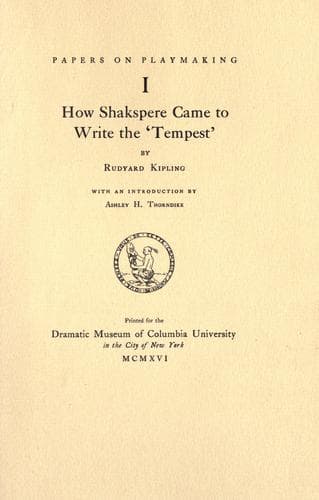
How Shakspere Came to Write the TempestKipling, Rudyard
General
How Shakspere Came to Write the Tempest
Kipling, Rudyard
Shakespeare, William, 1564-1616. Tempest
In his little book, 'Shakspere's Sea Forms Explained,' (Bristol, 1910)
Mr. W. B. Whall, master mariner, expresses his belief that Shakspere's
use of sea phrases is copious and accurate. He declares that "Words and
phrases of an extremely technical nature are scattered thru" Shakspere's
plays; "and a mistake in their use is never made." Then he asks: "Could
a mere lubber have steered clear of error in the use of such terms?" (p.
6). Mr. Whall had earlier noted that there are seven years of
Shakspere's life as to which we have scarcely any information, and that
one of these years was the year of the Armada, 1588, when he had only
just attained his majority. Where was Shakspere and what was he doing?
"There was a hot press for men to man the fleet. Is it possible that he
was among the prest?" (p. 5).
It was a time of exaltation of all things pertaining to sea things; and
it is no wonder that the playwrights of the day, Heywood for one, made
frequent use of sea words. "The wonder is that without professional
acquaintance" Shakspere "should always use these terms correctly," (p.
18). He abounds in "Elizabethan sailor talk pure and simple." And a
little later Mr. Whall draws attention to the fact that "sea expressions
crop up in quite unexpected places"--just as theatrical expressions crop
up; "and that they are all phrased _as by a sailor_," (p. 19). Then Mr.
Whall quotes a remark from another master mariner, Captain Basil Hall,
who had earlier noticed this striking characteristic: "One would like to
know how Shakspere pickt it up."
When he comes to deal with the 'Tempest' Mr. Whall cites the saying of
Lord Mulgrave, some time first Lord of the Admiralty: "The first scene
of the 'Tempest' is a very striking instance of the great accuracy of
Shakspere's knowledge in a professional science." With this Mr. Whall
disagrees: "Now this does not of necessity follow. A playwright with any
sense would, if about to write such a scene, obtain professional
assistance unless he himself had professional knowledge to steer clear
of error. The whole scene is graphic, accurate and correct in the terms
of nautical speech.... But it is by no means such a proof of the
writer's sea knowledge as are the scattered and wholly unexpected
nautical references in many other plays, every one of which might have
been written by an experienced seaman."
The most recent and the most careful consideration of Shakspere's
acquaintance with seafaring life is contained in Mr. L. G. Carr
Laughton's essay on 'The Navy: Ships and Sailors,' contributed to
'Shakspere's England,' (Oxford University Press, 1916), 141-170.
A. H. T.
OF THIS BOOK THREE HUNDRED AND THIRTY-THREE COPIES WERE PRINTED FROM
TYPE BY CORLIES, MACY AND COMPANY IN SEPTEMBER : MCMXVI
Public-domain text, read in full here on John Shaqi.
Reviews
Reviews
No reviews yet
Be the first to share your thoughts on this work.
Join the Discussion
Join the discussion
Sign in to leave a comment or review.
Sign InorCreate an account