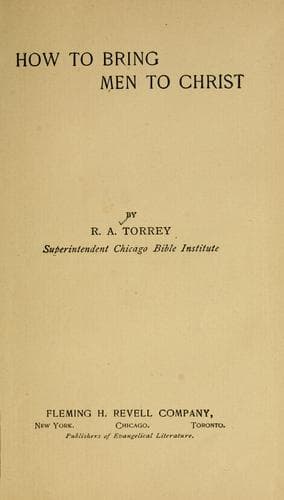
How to bring men to ChristTorrey, R. A. (Reuben Archer)
Religion
How to bring men to Christ
Torrey, R. A. (Reuben Archer)
Evangelistic work; Witness bearing (Christianity)
1. Among those who entertain false hopes, perhaps the largest class are
_those who expect to be saved by their righteous lives_. These persons
are easily known by such sayings as these, “I am doing the best I can.”
“I do more good than evil.” “I am not a great sinner.” “I have never
done anything very bad.” Gal. iii. 10, is an excellent passage to use,
for it shows that all those who are trusting in their works are under
the curse of the law and that there is no hope on the ground of the law
for any one who does not “continue in all things which are written in
the book of the law to do them.” James ii. 10 is also useful. Gal. ii.
16, and Romans iii. 19, 20 are very effective by showing that by the
deeds of the law there shall no flesh be justified in God’s sight. Matt.
v. 20—All these passages show the kind of righteousness God demands and
that no man’s righteousness comes up to God’s standard, and that if a
man wishes to be saved he must find some other means of salvation than
by his own deeds. It is sometimes well in using these passages to say to
the inquirer: “You do not understand the kind of righteousness that God
demands or you would not talk as you do. Now let us turn to His word and
see what kind of righteousness it is that God demands.” There is another
way of dealing with this class, by the use of such passages as Luke xvi.
15; Rom. ii. 16; 1 Sam. xvi. 7. These passages show that God looks at
the heart. Hold the inquirer right to that point. Every man when brought
face to face with that, must tremble because he knows that whatever his
outward life may be, his heart will not stand the scrutiny of God’s eye.
No matter how selfrighteous a man is, we need not be discouraged for
somewhere in the depths of every man’s heart is the consciousness of sin
and all we have to do is to work away until we touch that point. Every
man’s conscience is on our side. Matt. xxii. 37, 38 can be used when a
man says “I am doing the best I can, or doing more good than evil.” Say
to him, “You are greatly mistaken about that; so far from doing more
good than evil, do you know that you have broken the first and greatest
of God’s laws?” Then show him the passage. Heb. xi. 6, John vi. 29, show
that the one thing that God demands is faith and that without that it is
impossible to please God, and John xvi. 9, shows that unbelief in Christ
is the greatest sin. John iii. 36, shows that the question of eternal
life depends solely upon a man’s accepting or rejecting Jesus Christ,
and Heb. x. 28, 29, that the sin which brings the heaviest punishment is
that of treading under foot the Son of God. Before using this latter
passage, it would be well to say, “You think you are very good, but do
you know that you are committing the most awful sin in God’s sight which
a man can commit?” If he replies, “No,” then say “Well let me show you
from God’s word that you are;” then turn to this passage and read it
with great solemnity and earnestness.
Public-domain text, read in full here on John Shaqi.
Reviews
Reviews
No reviews yet
Be the first to share your thoughts on this work.
Join the Discussion
Join the discussion
Sign in to leave a comment or review.
Sign InorCreate an account