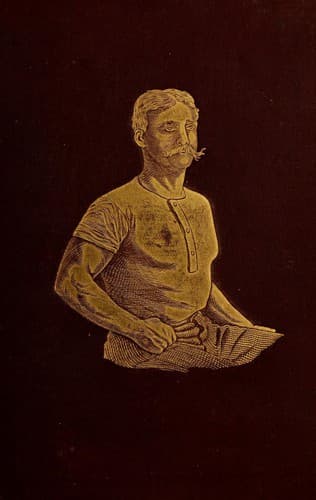
How to Get Strong and How to Stay SoBlaikie, William
Science
How to Get Strong and How to Stay So
Blaikie, William
Physical education and training
Nor do these include all the muscles which the foot-work arouses to
action. Take the horizontal bands or layers of muscle across the
abdomen. Every step forward moves them, and the higher and more
energetic the step, the more they have to do. A man who is not strong in
these muscles will usually have a feeble walk, and very often will
double forward a little, until he is in about the position of the two
hands of a clock at two minutes past six, giving him the appearance of
being weak here. But the strong, high step tilts the body slightly back,
and gives these muscles so much to do that they soon grow good at it,
and shapely and powerful accordingly.
Another advantage comes from having these muscles strong, and from
forming the habit of stepping as he does who has them so. By walking
thus erect, the shoulders, instead of pressing over on the chest as the
man tires, and so cramping his breathing, are so habitually held back
that it is easier to keep them there, and the consequent fuller
respiration keeps him longer fresh. This is very conspicuous in the case
of one of the most famous pedestrians in the world to-day, its
ex-champion long-distance walker, Daniel O'Leary. Take him when in good
condition, and in one of his long tramps; on the first mile or the four
hundredth, it is always the same: there he is, with head up, shoulders
well back, and working busily, and--the most noticeable thing--the whole
centre of the body, from the waist to the knees, thrown, if anything,
actually forward of a vertical line, instead of as far, or often much
farther, back of it; indeed, the point farthest forward is about two
inches below his belt. A fair though not clear idea of what is meant can
be had from the following sketch of him, taken at the time, on the
latter part of his five-hundred-mile walk with Hughes, "the Lepper," on
the track in the Hippodrome, in New York city, during the first week of
October, 1878. Hughes, while proving himself a very tough and determined
man, showed, as is too often the case with professional athletes,
great ignorance of many things which would have helped him much had
he known and followed them, and none more, perhaps, than this very
matter of correct position.
O'Leary's freshness, no matter how many hundred miles he has just
walked, is remarkable. This rational way of carrying the body during a
difficult feat, besides giving the heart and lungs full room for
vigorous action, also gives the stomach and other vital organs ample
play; for a glance at the sketch shows none of the thinness of flank
and general sunken-in look at the waist in O'Leary so plain in Hughes,
and so common among walkers in the later miles of the race.
[Illustration: Fig. 6. A Correct Position for Fast Walking.]
Public-domain text, read in full here on John Shaqi.
Reviews
Reviews
No reviews yet
Be the first to share your thoughts on this work.
Elsewhere in the archive
Join the Discussion
Join the discussion
Sign in to leave a comment or review.
Sign InorCreate an account