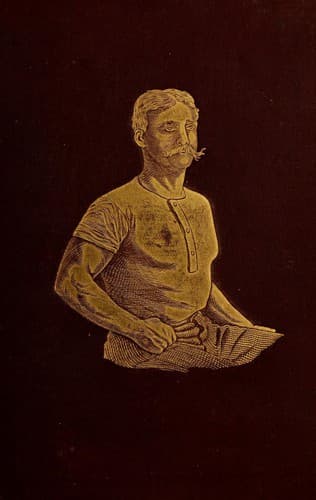
How to Get Strong and How to Stay SoBlaikie, William
Science
How to Get Strong and How to Stay So
Blaikie, William
Physical education and training
Every one of the exercises for the biceps tells also on the pectoral
muscles, or those on the front of the upper part of the chest, for the
two work so intimately together that he who has a large biceps is
practically sure to have the adjoining pectoral correspondingly large.
But there is other work which tells on them besides biceps work.
Whenever the hands push hard against anything, and so call the triceps
muscles into action, these muscles at once combine with them. In the
more severe triceps work, such as the dips, the strain across these
chest-muscles is very great, for they are then a very important factor
in helping to hold up the weight of the whole body. This fact suggests
the folly of letting any one try so severe a thing as a dip, when his
triceps and pectoral muscles have not been used to any such heavy work.
Many a person who has rashly attempted this has had to pay for it with a
pain for several days at the edge of the pectoral, where it meets the
breastbone, until he concluded he must have broken something.
Working with the dumb-bells when the arms are extended at right angles
with the body, like a cross, and raising them up and down for a foot or
so, is one of the best things for the upper edge of the pectorals, or
that part next to the collar-bone.
This brings us to a matter of great importance, and one often
overlooked. Whoever knows many gymnasts, and has seen them, stripped or
in exercising costume, must occasionally have observed that, while they
had worked at exercises which brought up these pectoral muscles until
they were almost huge, their chests under their muscles had somehow not
advanced accordingly. Indeed, in more than one instance which has come
under our observation, the man looked as though, should you scrape all
these great muscles completely off, leaving the bare framework, he would
have actually a small chest, much smaller than many a fellow who had not
much muscle. There hangs to-day--or did some time since--on the wall of
a well-known New York gymnasium, a portrait of a gymnast stripped above
the waist, which shows an exact case in point. The face of such a man is
often a weak one, lacking the strength of cheek-bone and jaw so usual in
men of great vitality and sturdiness--like Morrissey, for instance--and
there is a general look about it as if the man lacked vitality. Many a
gymnast has this appearance, for he takes so much severe muscular work
that it draws from his vitality, and gives him a stale and exhausted
look, a very common one, for example, among men who remain too long in
training for contest after contest of an athletic sort.
The getting up, then, of a large chest, and of large muscles on the
chest, while often contemporary, and each aiding the other, are too
frequently wholly different matters.
And how is the large chest to be had?
_To Broaden and Deepen the Chest itself._
Public-domain text, read in full here on John Shaqi.
Reviews
Reviews
No reviews yet
Be the first to share your thoughts on this work.
Elsewhere in the archive
Join the Discussion
Join the discussion
Sign in to leave a comment or review.
Sign InorCreate an account