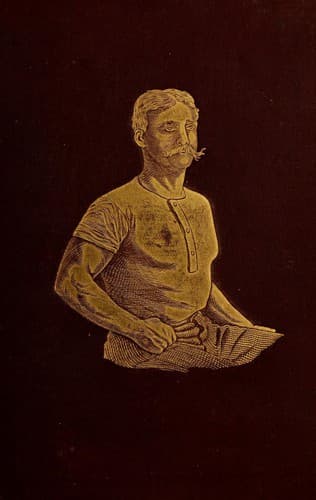
How to Get Strong and How to Stay SoBlaikie, William
Science
How to Get Strong and How to Stay So
Blaikie, William
Physical education and training
Anything which causes one to frequently fill his lungs to their utmost
capacity, and then hold them full as long as he can, tends directly to
open his ribs, stretch the intercostal muscles, and so expand the
chest. Many kinds of vigorous muscular exercise do this when done
correctly, for they cause the full breathing, and at the same time
directly aid in opening the ribs. It will be observed that frequently
throughout these hints about exercising, endeavor has been made to
impress on the reader that, when exercising, he should hold the head and
neck rigidly erect, and the chest as high as he can. A moment's thought
will show why. He, for instance, who "curls" a heavy dumb-bell, but does
it with his head and shoulders bent over--as many do--while giving his
pectorals active work, is actually tending to cramp his chest instead of
expanding it, the very weight of the dumb-bell all pulling in the wrong
direction. Now, had he held himself rigidly erect, and, first expanding
his chest to its utmost by inhaling all the air he possibly could, and
holding it in during the effort--a most valuable practice, by-the-way,
in all feats calling for a great effort--he would not only have
helped to expand his chest, but would find, to his gratification,
that he had hit upon a wrinkle which somehow made the task easier
than it ever was before.
Holding the head and neck back of the vertical, say six inches, with
the face pointing to the ceiling, and then working with the dumb-bells
at arm's-length, as above referred to, is grand for the upper chest,
tending to raise the depressed collar-bones and the whole upper
ribs, and to make a person hitherto flat-chested now shapely and
full; while the benefit to lungs perhaps formerly weak would be
hard to over-estimate.
Steady and protracted running is a great auxiliary in enlarging the
lung-room. So is plenty of sparring. So is the practice of drawing air
slowly in at the nostrils until every air-cell of the lungs is
absolutely full, then holding it long, and then expelling it slowly.
Most public singers and speakers know the value of this and kindred
practices in bringing, with increased diaphragmatic action, improved
power and endurance of voice.
Spreading the parallel bars until they are nearly three feet apart, and
doing such arm-work on them as you can, but with your body below and
face downward, helps greatly in expanding the chest. So does swinging
from the rings or bar overhead, or high parallels, and remaining on them
as long as you can.
Public-domain text, read in full here on John Shaqi.
Reviews
Reviews
No reviews yet
Be the first to share your thoughts on this work.
Elsewhere in the archive
Join the Discussion
Join the discussion
Sign in to leave a comment or review.
Sign InorCreate an account