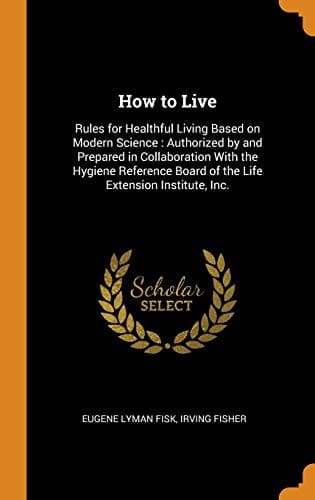
How to Live: Rules for Healthful Living Based on Modern ScienceFisher, Irving
Science
How to Live: Rules for Healthful Living Based on Modern Science
Fisher, Irving
Hygiene
For some persons the inevitable mode of improvement will be by
substituting the milder drugs for the stronger--beer for spirits, weak
tea for beer. The exact extent to which the milder poisons are injurious
has not yet been scientifically settled. Tea, for instance, if very weak
and used moderately, is, presumably, not injurious to any marked degree
to healthy persons. The trouble is, however, that sensitive people do
not keep moderate. In fact, the natural tendency of drug-craving is in
the opposite direction, from weak drugs to strong ones, as from beer to
spirits. In actual fact, it is much easier to abstain than to be
moderate. It should also be noted that the lax spirit in which many
people make an exception to the rules of health in favor of some mild
indulgence is very likely to lead to the making of many other exceptions
until they are, without knowing it, carrying a heavy load made up of
scores of little items of harmful indulgence. Moreover, experiments at
the Pasteur Institute have shown that the long-continued use of very
minute doses of poison ultimately produces appreciable harm. Each person
must decide for himself how far he chooses to depart from previous
habits or common customs for the sake of physical efficiency. The object
here is to state exactly what, in our present state of knowledge, is
believed to be the truth.
Those with feeble digestions or unstable nervous systems are especially
harmed by these poisons. A family history of nervously inclined people
calls for rigid care in such matters.
[Sidenote: Alcohol]
Scientific experiments have resulted in the interesting discovery that
the alleged "strength" obtained from beer, ales, and all intoxicating
beverages is a delusion and a snare. The poison simply gives a temporary
feeling of greater strength through paralysis of the sense of fatigue.
But the strength does not exist. On the contrary, the user of alcohol in
excess is weaker after taking it. Special classes of workmen have been
tested as to their efficiency under liquor in small amounts and without
it entirely, and it was invariably found that the liquor was a handicap,
but that, also invariably, the workmen _thought_ they could work harder
by its aid! Alcohol numbs the sense of fatigue and so deceives the user.
It is not a stimulant but a narcotic. The habit of taking a cocktail
before meals is doubly harmful, because it is often taken on an empty
stomach and because it poisons the system more quickly than when mixed
with food and retained in the intestines.
[Sidenote: Alcohol and Infectious Diseases]
Public-domain text, read in full here on John Shaqi.
Reviews
Reviews
No reviews yet
Be the first to share your thoughts on this work.
Join the Discussion
Join the discussion
Sign in to leave a comment or review.
Sign InorCreate an account