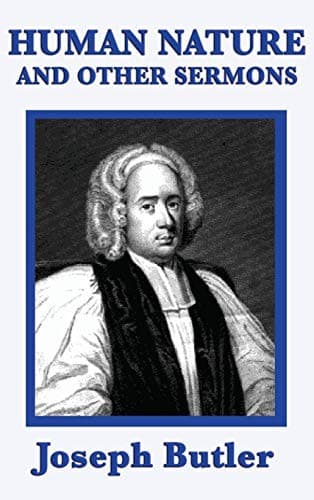
Church of England -- Sermons; Ethics; Sermons, English
_Thou shalt shew me the path of life_; _in Thy presence is the fulness of
joy_, _and at Thy right hand there is pleasure for evermore_.
Footnotes:
{1} 1 Cor. xii
{2} Suppose a man of learning to be writing a grave book upon _human
nature_, and to show in several parts of it that he had an insight into
the subject he was considering, amongst other things, the following one
would require to be accounted for--the appearance of benevolence or good-
will in men towards each other in the instances of natural relation, and
in others. {2a} Cautions of being deceived with outward show, he retires
within himself to see exactly what that is in the mind of man from whence
this appearance proceeds; and, upon deep reflection, asserts the
principle in the mind to be only the love of power, and delight in the
exercise of it. Would not everybody think here was a mistake of one word
for another--that the philosopher was contemplating and accounting for
some other _human actions_, some other behaviour of man to man? And
could any one be thoroughly satisfied that what is commonly called
benevolence or good-will was really the affection meant, but only by
being made to understand that this learned person had a general
hypothesis, to which the appearance of good-will could no otherwise be
reconciled? That what has this appearance is often nothing but ambition;
that delight in superiority often (suppose always) mixes itself with
benevolence, only makes it more specious to call it ambition than hunger,
of the two: but in reality that passion does no more account for the
whole appearances of good-will than this appetite does. Is there not
often the appearance of one man's wishing that good to another, which he
knows himself unable to procure him; and rejoicing in it, though bestowed
by a third person? And can love of power any way possibly come in to
account for this desire or delight? Is there not often the appearance of
men's distinguishing between two or more persons, preferring one before
another, to do good to, in cases where love of power cannot in the least
account for the distinction and preference? For this principle can no
otherwise distinguish between objects than as it is a greater instance
and exertion of power to do good to one rather than to another. Again,
suppose good-will in the mind of man to be nothing but delight in the
exercise of power: men might indeed be restrained by distant and
accidental consideration; but these restraints being removed, they would
have a disposition to, and delight in, mischief as an exercise and proof
of power: and this disposition and delight would arise from, or be the
same principle in the mind, as a disposition to and delight in charity.
Thus cruelty, as distinct from envy and resentment, would be exactly the
same in the mind of man as good-will: that one tends to the happiness,
the other to the misery, of our fellow-creatures, is, it seems, merely an
Public-domain text, read in full here on John Shaqi.
Reviews
Reviews
No reviews yet
Be the first to share your thoughts on this work.
Elsewhere in the archive
Join the Discussion
Join the discussion
Sign in to leave a comment or review.
Sign InorCreate an account