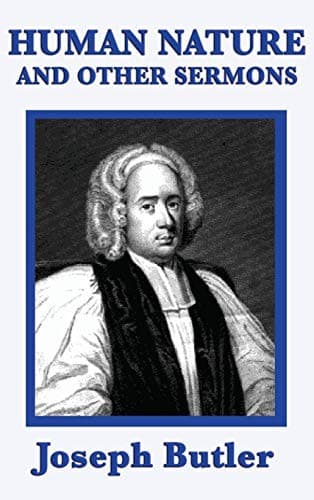
Church of England -- Sermons; Ethics; Sermons, English
accidental circumstance, which the mind has not the least regard to.
These are the absurdities which even men of capacity run into when they
have occasion to belie their nature, and will perversely disclaim that
image of God which was originally stamped upon it, the traces of which,
however faint, are plainly discernible upon the mind of man.
If any person can in earnest doubt whether there be such a thing as good-
will in one man towards another (for the question is not concerning
either the degree or extensiveness of it, but concerning the affection
itself), let it be observed that _whether man be thus_, _or otherwise
constituted_, _what is the inward frame in this particular_ is a mere
question of fact of natural history not provable immediately by reason.
It is therefore to be judged of and determined in the same way other
facts or matters of natural history are--by appealing to the external
senses, or inward perceptions respectively, as the matter under
consideration is cognisable by one or the other: by arguing from
acknowledged facts and actions for a great number of actions in the same
kind, in different circumstances, and respecting different objects, will
prove to a certainty what principles they do not, and to the greatest
probability what principles they do, proceed from: and, lastly, by the
testimony of mankind. Now that there is some degree of benevolence
amongst men may be as strongly and plainly proved in all these ways, as
it could possibly be proved, supposing there was this affection in our
nature. And should any one think fit to assert that resentment in the
mind of man was absolutely nothing but reasonable concern for our own
safety, the falsity of this, and what is the real nature of that passion,
could be shown in no other ways than those in which it may be shown that
there is such a thing in _some degree_ as real good-will in man towards
man. It is sufficient that the seeds of it be implanted in our nature by
God. There is, it is owned, much left for us to do upon our own heart
and temper; to cultivate, to improve, to call it forth, to exercise it in
a steady, uniform manner. This is our work: this is virtue and religion.
{2a} Hobbes, "Of Human Nature," c. ix. 7.
Public-domain text, read in full here on John Shaqi.
Reviews
Reviews
No reviews yet
Be the first to share your thoughts on this work.
Elsewhere in the archive
Join the Discussion
Join the discussion
Sign in to leave a comment or review.
Sign InorCreate an account