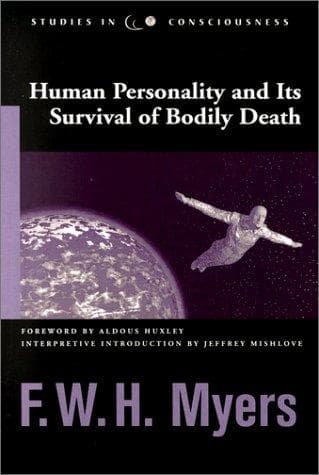
Human Personality and Its Survival of Bodily Death — John Shaqi
Human Personality and Its Survival of Bodily DeathMyers, F. W. H. (Frederic William Henry)
Religion
Human Personality and Its Survival of Bodily Death
Myers, F. W. H. (Frederic William Henry)
Immortality; Parapsychology; Personality
_Veridical._--Of hallucinations, when they correspond to real events
happening elsewhere and unknown to the percipient.
CHAPTER I
INTRODUCTION
Maior agit deus, atque opera la maiora remittit.
--VIRGIL.
In the long story of man's endeavours to understand his own environment
and to govern his own fates, there is one gap or omission so singular
that, however we may afterwards contrive to explain the fact, its simple
statement has the air of a paradox. Yet it is strictly true to say that
man has never yet applied to the problems which most profoundly concern
him those methods of inquiry which in attacking all other problems he
has found the most efficacious.
The question for man most momentous of all is whether or no he has an
immortal soul; or--to avoid the word _immortal_, which belongs to the
realm of infinities--whether or no his personality involves any element
which can survive bodily death. In this direction have always lain the
gravest fears, the farthest-reaching hopes, which could either oppress
or stimulate mortal minds.
On the other hand, the method which our race has found most effective in
acquiring knowledge is by this time familiar to all men. It is the
method of modern Science--that process which consists in an
interrogation of Nature entirely dispassionate, patient, systematic;
such careful experiment and cumulative record as can often elicit from
her slightest indications her deepest truths. That method is now
dominant throughout the civilised world; and although in many directions
experiments may be difficult and dubious, facts rare and elusive,
Science works slowly on and bides her time,--refusing to fall back upon
tradition or to launch into speculation, merely because strait is the
gate which leads to valid discovery, indisputable truth.
I say, then, that this method has never yet been applied to the
all-important problem of the existence, the powers, the destiny of the
human soul.
Nor is this strange omission due to any general belief that the problem
is in its nature incapable of solution by any observation whatever which
mankind could make. That resolutely agnostic view--I may almost say that
scientific superstition--"_ignoramus et ignorabimus_"--is no doubt held
at the present date by many learned minds. But it has never been the
creed, nor is it now the creed, of the human race generally. In most
civilised countries there has been for nearly two thousand years a
distinct belief that survival has actually been proved by certain
phenomena observed at a given date in Palestine. And beyond the
Christian pale--whether through reason, instinct, or superstition--it
has ever been commonly held that ghostly phenomena of one kind or
another exist to testify to a life beyond the life we know.
Public-domain text, read in full here on John Shaqi.
Reviews
Reviews
No reviews yet
Be the first to share your thoughts on this work.
Join the Discussion
Join the discussion
Sign in to leave a comment or review.
Sign InorCreate an account