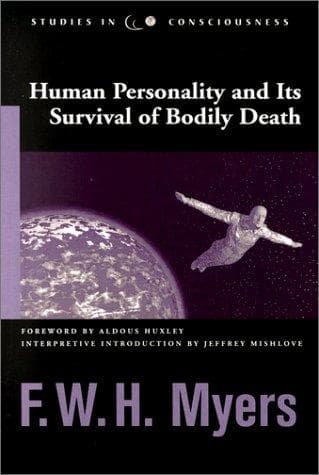
Human Personality and Its Survival of Bodily DeathMyers, F. W. H. (Frederic William Henry)
Religion
Human Personality and Its Survival of Bodily Death
Myers, F. W. H. (Frederic William Henry)
Immortality; Parapsychology; Personality
Dase trailed it after
him, as the poet says of the clouds of glory, when he "descended into
generation" in a humble position at Hamburg.
In him and in his ancestors were many faculties which were called out by
the struggle for existence, and became supraliminal. But there were many
faculties also which were not thus called out, and which consequently
remained subliminal. To these faculties, as a rule, his supraliminal
self could get no access. But by some chance of evolution--some sport--a
vent-hole was opened at this one point between the different strata of
his being, and a subliminal uprush carried his computative faculty into
the open day.
Two things, of course, are assumed in this argument for which Science
offers no guarantee. I assume in the man a soul which can draw strength
and grace from a spiritual Universe, and conversely I assume in the
Universe a Spirit accessible and responsive to the soul of man. These
are familiar postulates. Every religion has claimed them in turn;
although every religion in turn has so narrowed their application as
grievously to narrow the evidence available for their support. But that
which religions have claimed for their Founders or for their Saints--and
what is sanctity but the genius of the ethical realm?--Psychology must
claim for every form of spiritual indrawing, every form of spiritual
response; for sleeping vision, for hypnotic rejuvenation, for sensory
and motor automatisms, for trance, for ecstasy. The philosopher who has
cried with Marcus Aurelius "Either Providence or atoms!"--who has
declared that without this basis in the Unseen, "the moral Cosmos would
be reduced to a Chaos";--should he not welcome even the humblest line of
research which fain would gather from every unsolved problem some hint
as to the spiritual law unknown which in time may give the solution of
all?
We know not in what directions--directions how definitely
predetermined--even physical organisms can vary from the common type. We
know not what amount of energy any given plant or animal can absorb and
incorporate from earth and air and sun. Still less can we predict or
limit the possible variations of the soul, the fulness which it may
receive from the World-Soul, its possible heritage of grace and truth.
But in genius we can watch at each stage the processes of this celestial
nurture. We can imagine the outlook of joyous trustfulness; we can
almost seem, with Wordsworth, to remember the child's soul entering into
the Kingdom of Heaven. Childhood is genius without capacity; it makes
for most of us our best memory of inspiration, and our truest outlook
upon the real, which is the ideal, world.
From a greater distance we can watch the inward stir of mighty thought,
the same for Æschylus, for Newton, for Virgil;--a stir independent of
worldly agitation; like the swing and libration of the tide-wave across
the ocean, which takes no note of billow or of storm.
Public-domain text, read in full here on John Shaqi.
Reviews
Reviews
No reviews yet
Be the first to share your thoughts on this work.
Elsewhere in the archive
Join the Discussion
Join the discussion
Sign in to leave a comment or review.
Sign InorCreate an account