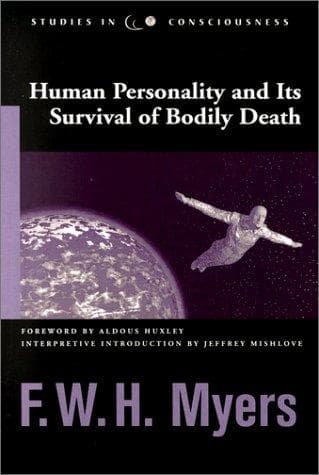
Human Personality and Its Survival of Bodily DeathMyers, F. W. H. (Frederic William Henry)
Religion
Human Personality and Its Survival of Bodily Death
Myers, F. W. H. (Frederic William Henry)
Immortality; Parapsychology; Personality
This view, if pushed back far enough, is no doubt inconsistent with the
way in which evolution is generally conceived. For it denies that all
human faculties must have been evoked by terrene experience. It assumes
a subliminal self, with unknown faculties, originated in some unknown
way, and not merely by contact with the needs which the terrene organism
has had to meet. It thus seems at first sight to be introducing a new
mystery, and to be introducing it in a gratuitous way.
To this I reply in the first place that so far as the origin of man's
known powers is concerned, no fresh mystery is in fact introduced. All
human powers, to put the thing broadly, have somehow or other to be got
into protoplasm and then got out again. You have to explain first how
they became implicit in the earliest and lowest living thing, and then
how they have become thus far explicit in the latest and highest. All
the faculties of that highest being, I repeat, existed _virtually_ in
the lowest, and in so far as the admitted faculties are concerned, the
difference between my view and the ordinary view may be said to be
little more than a difference as to the sense which that word
_virtually_ is here to assume.
The real difference between the two views appears when the faculties
which I have called unknown come to be considered. If they are held to
be real, my view is certainly the better able to embrace them. I hold
that telepathy and telæsthesia do in fact exist--telepathy, a
communication between incarnate mind and incarnate mind, and perhaps
between incarnate minds and minds unembodied; telæsthesia, a knowledge
of things terrene which overpasses the limits of ordinary perception,
and which perhaps also achieves an insight into some other than terrene
world. And these faculties, I say, cannot have been acquired by natural
selection, for the preservation of the race, during the process of
terrene evolution; they were (as we may phrase it) the products of
extra-terrene evolution. And if they were so, man's other powers may
well have been so also. The specialised forms of terrene perception were
not real novelties in the universe, but imperfect adaptations of
protoplasm to the manifestation of the indwelling general perceptive
power. The mathematical faculty, for instance (we may, perhaps, say
with Plato), pre-existed. When Dase solved all those sums in his head,
his power of solving them was not a fresh development in his ancestral
stock, but depended on the accidental adaptation of his organism to the
manifestation of the indwelling computative power. I do not indeed
venture to follow Plato in his ontogenetic argument--his claim that the
individual computator has had already an individual training in
computation. I do not say that Dase himself learnt or divined the
multiplication-table in some ideal world. I only say that Dase and all
the rest of us are the spawn or output of some unseen world in which the
multiplication-table is, so to speak, in the air.
Public-domain text, read in full here on John Shaqi.
Reviews
Reviews
No reviews yet
Be the first to share your thoughts on this work.
Elsewhere in the archive
Join the Discussion
Join the discussion
Sign in to leave a comment or review.
Sign InorCreate an account