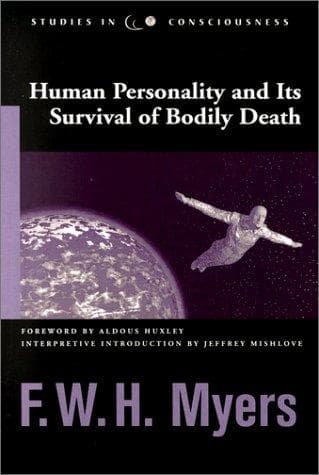
Human Personality and Its Survival of Bodily DeathMyers, F. W. H. (Frederic William Henry)
Religion
Human Personality and Its Survival of Bodily Death
Myers, F. W. H. (Frederic William Henry)
Immortality; Parapsychology; Personality
"Hypnotic trance," says Bernheim, in effect, "is ordinary sleep;
hypnotic suggestion is ordinary command. You tell the patient to go to
sleep, and he goes to sleep; you tell him to get well, and he gets well
immediately." Even thus (one thinks) has one heard the conjuror
explaining "how it's done,"--with little resulting hope of emulating his
brilliant performance. An ordinary command does _not_ enable an ordinary
man to get rid of his rheumatism, or to detest the previously too
acceptable taste of brandy. In suggestion, in short, there must needs be
something more than a name; a profound nervous change must needs be
started by some powerful nervous stimulus from without or from within.
Before contenting ourselves with Bernheim's formula, we must consider
yet again what change we want to effect, and whether hypnotists have
actually used any form of stimulus which was likely to effect it.
According to Bernheim we are all naturally suggestible, and what we want
to effect through suggestion is increased suggestibility. But let us get
rid for the moment of that oracular word. What it seems to mean here is
mainly a readier obedience of the organism to what we wish it to do. The
sleep or trance with which hypnotism is popularly identified is not
essential to our object, for the subliminal modifications are sometimes
attained without any trace of somnolence. Let us consider, then, whether
any known nervous stimuli, either massive or specialised, tend to
induce--not mere sleep or catalepsy--but that kind of ready
modifiability,--of _responsiveness_ both in visible gesture and in
invisible nutritive processes,--for the sake of which hypnosis is in
serious practice induced.
Now of the external stimuli which influence the whole nervous system the
most conspicuous are narcotic drugs. Opium, alcohol, chloroform,
cannabis indica, etc., affect the nerves in so many strange ways that
one might hope that they would be of use as hypnotic agents. And some
observers have found that slight chloroformisation rendered subjects
more suggestible. Janet has cited one case where suggestibility was
developed during recovery from delirium tremens. Other hypnotisers (as
Bramwell) have found chloroform fail to render patients hypnotisable;
and alcohol is generally regarded as a positive hindrance to hypnotic
susceptibility. More experiment with various narcotics is much needed;
but thus far the scantiness of proof that narcotics help towards
hypnosis goes rather against the view that hypnosis is a direct
physiological sequence from any form of external stimulus.
Public-domain text, read in full here on John Shaqi.
Reviews
Reviews
No reviews yet
Be the first to share your thoughts on this work.
Elsewhere in the archive
Join the Discussion
Join the discussion
Sign in to leave a comment or review.
Sign InorCreate an account