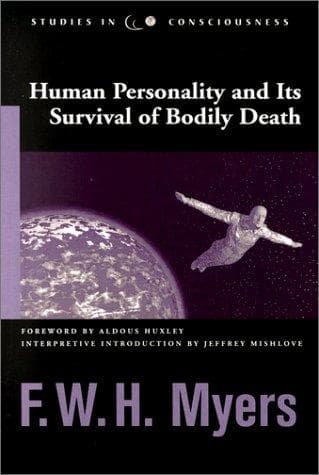
Human Personality and Its Survival of Bodily DeathMyers, F. W. H. (Frederic William Henry)
Religion
Human Personality and Its Survival of Bodily Death
Myers, F. W. H. (Frederic William Henry)
Immortality; Parapsychology; Personality
The apparent resemblance, indeed, between narcosis and hypnosis
diminishes on a closer analysis. A stage may occur both in narcotised
and in hypnotised subjects where there is incoherent, dream-like
mentation; but in the narcotised subject this is a step towards
inhibition of the whole nervous energy--the highest centres being
paralysed first; whereas in hypnosis the inhibition of supraliminal
faculty seems often at least to be merely a necessary preliminary to the
liberation of fresh faculty which presently manifests itself from a
profounder region of the self.
Next take another group of massive effects produced on the nervous
system by external stimuli;--those forms, namely, of trance and
cataplexy which are due to sudden shock. With human beings this
phenomenon varies from actual death from failure of heart-action, or
paralysis, or _stupor attonitus_ (a recognised form of insanity), any of
which may result from a mere alarming sight or unwelcome announcement,
down to the cataleptic immobility of a Salpêtrière patient, when she
hears a sudden stroke on the gong.
Similar phenomena in certain animals, as frogs, beetles, etc., are well
known. It is doubtful, however, whether any of these sudden disablements
should be classed as true hypnoses. It has not, I think, been shown that
in any case they have induced any real responsiveness to control, or
power of obeying suggestion; unless it be (as in some Salpêtrière cases)
a form of suggestion so obvious and habitual that the obedience thereto
may be called part of the actual cataplexy itself. Thus the "wax-like
flexibility" of the cataleptic, whose arms remain in the position where
you place them, must not be regarded as a readier obedience to control,
but rather as a state which involves not a more but a less alert and
capable responsiveness of the organism to either external or internal
stimuli.
So with regard to animals--crocodiles, frogs, and the like. I hold
theoretically that animals are probably hypnotisable and suggestible;
and the records of Rarey's horse-taming, etc., seem to point in that
direction.[60] But in the commoner experiments with frogs, where mere
passivity is produced, the resemblance seems to extend only to the
lethargic stage in human beings,[61] and what relation that lethargy
bears to suggestibility is not, I think, really known; although I shall
later on suggest some explanation on psychological grounds.
It seems plain, at any rate, that it must be from stimuli applied to men
and not to animals, and from stimuli of a special and localised rather
than of a massive kind, that we shall have to learn whatever can be
learnt as to the genesis of the true hypnotic control.
Public-domain text, read in full here on John Shaqi.
Reviews
Reviews
No reviews yet
Be the first to share your thoughts on this work.
Elsewhere in the archive
Join the Discussion
Join the discussion
Sign in to leave a comment or review.
Sign InorCreate an account