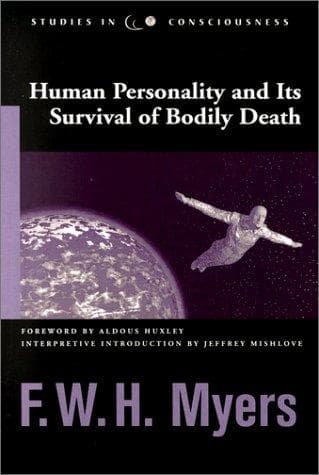
Human Personality and Its Survival of Bodily DeathMyers, F. W. H. (Frederic William Henry)
Religion
Human Personality and Its Survival of Bodily Death
Myers, F. W. H. (Frederic William Henry)
Immortality; Parapsychology; Personality
These _schemes of self-suggestion_, as I have termed them, constitute
one of the most interesting parts of my subject, but space forbids that
I should enter into a discussion of them here. It is sufficient to point
out that in order to make self-suggestion operative, no strong belief or
enthusiasm, such as those schemes imply, is really necessary. No
recorded cases of self-suggestion, I think, are more instructive than
those published by Dr. Hugh Wingfield in _Proceedings_ S.P.R., vol. v.
p. 279. (The paper was printed anonymously.) Dr. Wingfield was a
Demonstrator in Physiology in the University of Cambridge, and his
subjects were mainly candidates for the Natural Sciences Tripos. In
these cases there was no excitement of any kind, and no previous belief.
The phenomena occurred incidentally during a series of experiments on
other points, and were a surprise to every one concerned. The results
achieved were partly automatic writing and partly phenomena of
neuro-muscular excitability;--stiffening of the arms, and so forth. "It
seems probable," says Dr. Wingfield, "that all phenomena capable of
being produced by the suggestion of the hypnotiser can also be produced
by self-suggestion in a self-suggestive subject."
Experiments like these--confirming with modern care the conclusions
reached by Fahnestock and others at various points in hypnotic
history--seem to me to open a new inlet into human faculty, as
surprising in its way as those first wild experiments of Mesmer himself.
Who would have supposed that a healthy undergraduate could "by an effort
of mind" throw his whole body into a state of cataleptic rigidity, so
that he could rest with his heels on one chair and his head on another?
or that other healthy young men could "close their own eyes so that they
were unable to open them," and the like? The trivial character of these
laboratory experiments makes them physiologically the more remarkable.
There is the very minimum of predisposing conditions, of excited
expectation, or of external motive prompting to extraordinary effort.
And the results are not subjective merely--relief of pain and so
on--but are definite neuro-muscular changes, capable (as in the case of
the head and heels on separate chairs) of unmistakable test.
Yet, important though these and similar experiments in self-suggestion
may be, they do not solve our problem as to the ultimate origin and
distribution of the faculty thus displayed. We know no better with
self-suggestion than with suggestion from outside _why_ it is that one
man succeeds where others fail, or why a man who succeeds once fails in
his next attempt. Within the ordinary range of physiological
explanations nothing (I repeat) has as yet been discovered which can
guide us to the true nature or exciting causes of this characteristic
responsiveness of hypnosis. If we are to find any light, it must be in
some direction which has as yet been little explored.
Public-domain text, read in full here on John Shaqi.
Reviews
Reviews
No reviews yet
Be the first to share your thoughts on this work.
Elsewhere in the archive
Join the Discussion
Join the discussion
Sign in to leave a comment or review.
Sign InorCreate an account