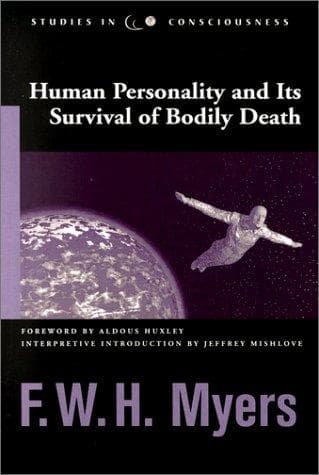
Human Personality and Its Survival of Bodily DeathMyers, F. W. H. (Frederic William Henry)
Religion
Human Personality and Its Survival of Bodily Death
Myers, F. W. H. (Frederic William Henry)
Immortality; Parapsychology; Personality
The man who sits down in his study to write or read,--in perfect safety
and intent on his work,--continues nevertheless to be involuntarily and
inevitably armed with all that alertness to external sights and sounds,
and all that sensibility to pain, which protected his lowly ancestors at
different stages of even pre-human development. It is much as though he
were forced to carry about with him all the external defences which his
forefathers have invented for their defence;--to sit at his
writing-table clad in chain-mail and a respirator, and grasping an
umbrella and a boomerang. Let him learn, if he can, inwardly as well as
outwardly, to get rid of all that, to keep at his command only the half
of his faculties which for his purpose is worth more than the whole.
Dissociation and choice;--dissociation between elements which have
always hitherto seemed inextricably knit;--choice between faculties
which till now we have had to use all together or not at all;--such is
the promise, such is the incipient performance of hypnotic plasticity in
its aspect of _inhibitive suggestion_.
I come now to the division of hypnotic achievement with which I next
proposed to deal, namely, the _dynamogenic_ results of hypnotic
suggestion. These I shall arrange in an order resembling that which we
try to follow in education:--proceeding from external senses to internal
sensory and other central operations; and thence again to attention and
will, and so to character which is a kind of resultant of all these.
I will begin, then, with what seems the most external and measurable of
these different influences--the influence, namely, of suggestion upon
man's _perceptive_ faculties;--its power to educate his external organs
of sense.
This wide subject is almost untouched as yet; and there is no direction
in which one could be more confident of interesting results from further
experiment.
The exposition falls naturally into three parts, as suggestion effects
one or other of the three following objects:
(1) Restoration of ordinary senses from some deficient condition.
(2) Verification of ordinary senses;--hyperæsthesiæ.
(3) Development of new senses;--heteræsthesiæ.
(1) The first of these three headings seems at first sight to belong to
therapeutics rather than to psychology. It is, however, indispensable as
a preliminary to the other two heads; since by learning how and to what
extent suggestion can repair _defective_ senses we have the best chance
of guessing at its _modus operandi_ when it seems to excite the
_healthy_ senses to a point beyond their normal powers.[77]
Public-domain text, read in full here on John Shaqi.
Human Personality and Its Survival of Bodily Death — John Shaqi
Reviews
Reviews
No reviews yet
Be the first to share your thoughts on this work.
Elsewhere in the archive
Join the Discussion
Join the discussion
Sign in to leave a comment or review.
Sign InorCreate an account