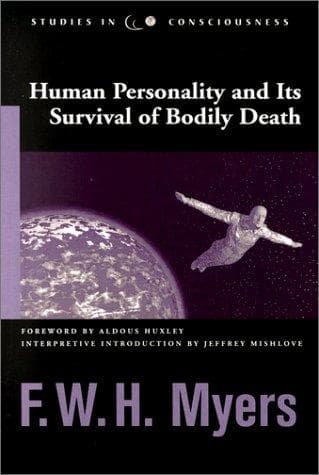
Human Personality and Its Survival of Bodily DeathMyers, F. W. H. (Frederic William Henry)
Religion
Human Personality and Its Survival of Bodily Death
Myers, F. W. H. (Frederic William Henry)
Immortality; Parapsychology; Personality
Two points may be mentioned here. Improvement of _vision_ seems
sometimes to result from relaxation of an involuntary ciliary spasm,
which habitually over-corrects some defect of the lens. This is
interesting, from the analogy thus shown in quite healthy persons to the
fixed ideas, the subliminal errors and fancies characteristics of
hysteria. The stratum of self whose business it is to correct the
mechanical defect of the eye has in these instances done so amiss, and
cannot set itself right. The corrected form of vision is as defective as
the form of vision which it replaced. But if the state of trance be
induced, or if it occur spontaneously, it sometimes happens that the
error is suddenly righted; the patient lays aside spectacles; and since
we must assume that the original defect of mechanism remains, it seems
that that defect is now perfectly instead of imperfectly met. This shows
a subliminal adjusting power operating during trance more intelligently
than the supraliminal intelligence had been able to operate during
waking life.
Another point of interest lies in the effect of increased attention, as
stimulated by suggestion, upon the power of hearing. Dr. Liébeault[78]
records two cases which are among the most significant that I know. If
such susceptibility to self-suggestion could be reached by patients
generally, there might be, with no miracle at all, a removal of perhaps
half the annoyance which deafness inflicts on mankind.
I pass on to cases of the production by suggestion or self-suggestion of
hyperæsthesia,--of a degree of sensory delicacy which overpasses the
ordinary level, and the previous level of the subject himself.
The rudimentary state of our study of hypnotism is somewhat strangely
illustrated by the fact that most of the experiments which show
hyperæsthesia most delicately have been undertaken with a view of
proving something else--namely, mesmeric _rapport_, or the mesmerisation
of objects, or telepathy. In these cases the proof of _rapport_,
telepathy, etc., generally just falls short,--because one cannot say
that the action of the ordinary senses might not have reached the point
necessary for the achievement, though there is often good reason to
believe that the subject was supraliminally ignorant of the way in which
he was, in fact, attaining the knowledge in question.
In these extreme cases, indeed, the explanation by hyperæsthesia is not
always proved. There _may_ have been telepathy, although one has not the
right to assume telepathy, in view of certain slighter, but still
remarkable, hyperæsthetic achievements, which are common subjects of
demonstration. The ready recognition of _points de repère_, on the back
of a card or the like, which are hardly perceptible to ordinary eyes, is
one of the most usual of these performances.
Public-domain text, read in full here on John Shaqi.
Reviews
Reviews
No reviews yet
Be the first to share your thoughts on this work.
Elsewhere in the archive
Join the Discussion
Join the discussion
Sign in to leave a comment or review.
Sign InorCreate an account